Self-Calibration & Diagnostics via Dual-Use OPC
Every OPC module already on the chip becomes a built-in sensor — measuring visibility, detecting degradation, and triggering self-healing in real time. Zero additional hardware overhead.
Quantum chips can't monitor themselves
Current photonic quantum processors require external test equipment, dedicated measurement ports, and offline calibration procedures. This wastes chip area on test structures, requires downtime for calibration, and provides no real-time visibility into processor health during computation.
Error correction modules as diagnostic sensors
QLT's OPC modules serve dual purposes: during computation they correct phase errors; during calibration they measure interference visibility, reflected power, and spectral response. This eliminates dedicated test structures, enables continuous monitoring during computation, and provides comprehensive chip health assessment with zero area overhead.
Technical Architecture
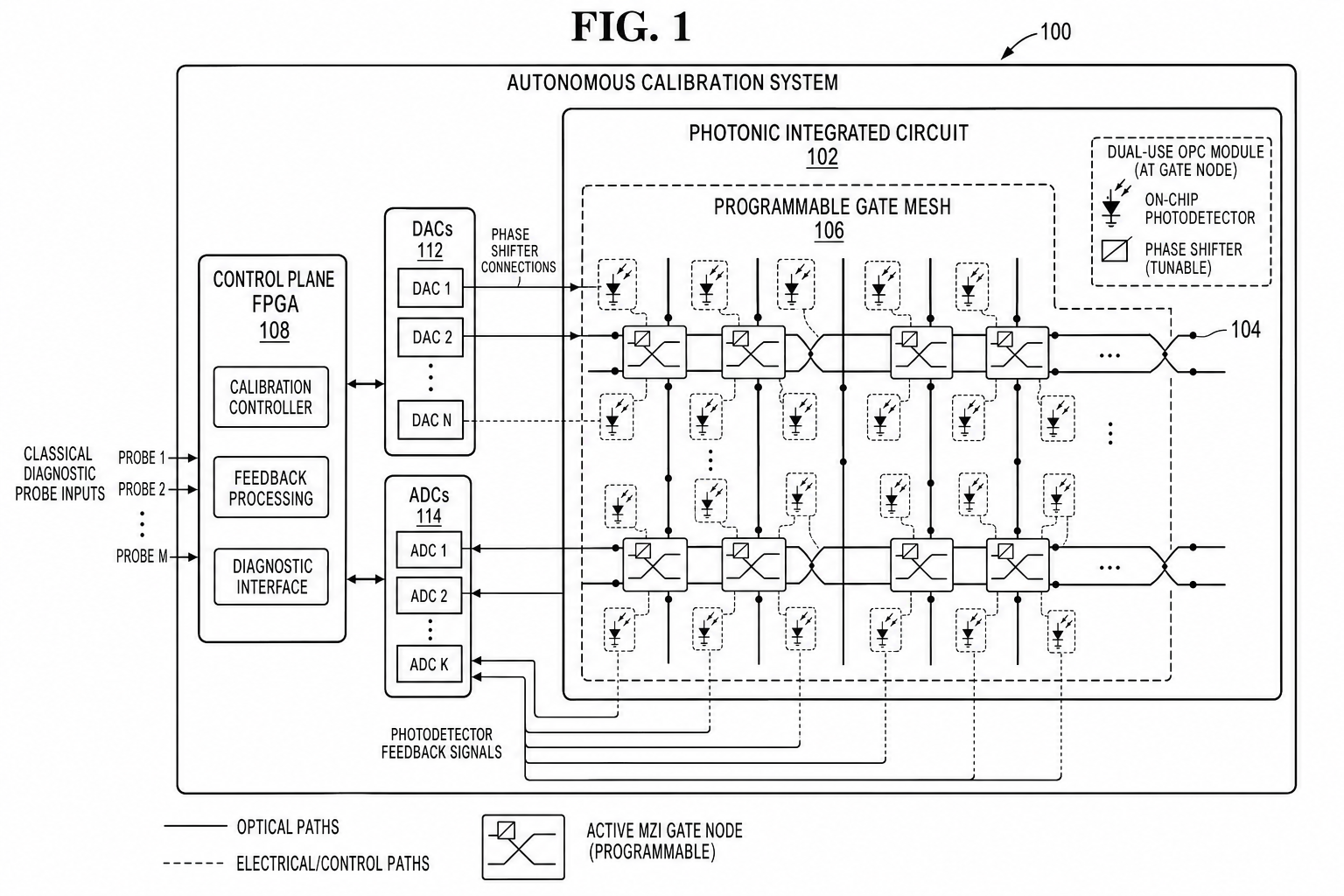
Programmable Interferometric Lattice
Photonic integrated circuit containing a programmable gate mesh of active MZI nodes arranged in an interferometric lattice. Dual-use OPC modules are distributed at gate nodes — serving as quantum coherence correction during computation and diagnostic sensors between cycles.
Real-Time Feedback Controller
FPGA-based digital control logic executes real-time feedback loops driven by OPC telemetry. Interfaces with the PIC via high-speed DACs (112) driving phase shifters and ADCs (114) capturing photodetector readings from each OPC module.
Correction + Diagnostic Paradigm
Each OPC module measures three diagnostic quantities: phase-conjugate visibility (V) for cumulative coherence, reflectivity (R) for path-integrated loss, and spectral shape for FWM phase-matching status. Zero additional chip area required for diagnostics.
Continuous Telemetry Acquisition
Tap photodiodes at each OPC module capture phase-conjugate returns from interleaved classical probe pulses. Provides per-cycle visibility updates at the monitoring rate without interrupting quantum computation.
Why this matters
No Dedicated Test Structures
The diagnostic function uses hardware already present for error correction. No additional waveguides, no extra detectors, no test pads. 100% of chip area serves the computation.
Non-Destructive Monitoring
Temporal-spectral multiplexing enables continuous health monitoring during live computation — without interrupting the quantum processing or degrading its performance.
Tiered Autonomous Response
A four-tier response hierarchy — from automatic parameter adjustment to graceful degradation — enables the processor to self-heal without human intervention.
Machine-Learning Calibration
ML-assisted optimization with transfer learning across fabrication batches accelerates bring-up of new chips — prior batch calibration data bootstraps the next batch.
Rapid Die Screening
OPC visibility measurements provide non-destructive die-level acceptance testing at wafer scale — dramatically reducing test time compared to functional quantum testing.
Degradation Forecasting
Trending OPC visibility over time enables predictive maintenance — identifying chips approaching failure before they degrade below acceptable performance thresholds.
Technical Specifications
| Parameter | Specification | Value |
|---|---|---|
| Dual-Use Paradigm | OPC modules serve as quantum coherence correction AND diagnostic sensors | 2 functions |
| Multiplexing Protocol | Temporal-spectral multiplexing for interleaved quantum/diagnostic windows | ~20 ns cycle |
| Diagnostic Window | Classical probe pulse duration during dead time between computation cycles | ~50 ps pulse |
| Self-Healing Hierarchy | Phase correction → pump adjust → route avoidance → segment isolation | 4 levels |
| Cold-Start Initialization | Powered-off state to operational readiness via OPC visibility feedback | <60 seconds |
| Transfer Learning | Batch-level initialization from prior fabrication batch telemetry database | Cross-batch |
| Wafer-Level Testing | Non-destructive die acceptance testing using OPC visibility & reflectivity | Per-die screening |
| Diagnostic Metrics | Visibility (V), reflectivity (R), and spectral shape at each OPC module | 3 quantities |
| Phase Accuracy | Quantum computation phase relationships for high-fidelity gates (>99%) | 0.01–0.1 rad |
| Area Overhead | Additional chip area required for diagnostic/calibration functionality | 0% |
Built on established science
Standard in Semiconductor Industry
BIST (built-in self-test) is a mature technique used in every CMOS chip. QLT applies the BIST paradigm to photonic quantum processors — dual-purposing existing optical elements.
Universal Quality Metric
Interference visibility (fringe contrast) is the standard metric for optical coherence quality, used across fiber optics, quantum optics, and photonic integrated circuits.
Cross-References
Patent 01 — Room-Temperature Quantum Processor
The processor architecture that Patent 12 makes production-ready. Self-calibration, continuous monitoring, and predictive maintenance transform the processor from a lab device into deployable infrastructure.
Patent 08 — Periodic Phase Conjugation Lattice
Defines the OPC lattice architecture that Patent 12 repurposes for diagnostics. The same modules that bound phase errors during computation become coherence sensors during calibration windows.
Patent 07 — OPC Neural Network Accelerator
RACT neural network calibration method that complements Patent 12's ML-assisted optimization. Transfer learning across fabrication batches accelerates bring-up of new processor chips.
Patent 02 — Self-Phase-Matched OPC Waveguide
The hybrid nonlinear waveguide that implements each OPC module. Patent 12's diagnostic metrics — visibility, reflectivity, spectral shape — directly measure the health of these Patent 02 waveguide elements.
Making quantum processors production-ready
Patent 12 transforms the processor from a lab device to a production product. Self-calibration, continuous monitoring, and predictive maintenance are requirements for enterprise deployment — and this patent provides them with zero incremental hardware.