LOTUS
Long-horizon Optical Telecom Ultra-Spectral field machine
QUASAR · d=512 · GF(2⁹) · Region IV · Long-term research
LOTUS is QLT's long-horizon Region IV coherent spectral machine — a 512-bin frequency-field processor spanning ~10.2 THz at Δf = 20 GHz, stabilized by distributed continuous OPC (not discrete refresh stages), carrying 261,632 pairwise phase relationships and ~134M degenerate FWM pathways, where continuous-variable field dynamics dominate the Q-metric (Q > 1) and GF(512) algebraic structure is a secondary control layer beneath CV stabilization.
LOTUS specification ledger
Canonical numbers from WS13 Δf table and S71–S80 corpus.
| Property | Value | Status |
|---|---|---|
| Hilbert dimension d | 512 = 2⁹ | roadmap |
| Algebraic layer | GF(512) = GF(2⁹) — secondary | speculative-framework |
| Bits / photon | 9 | info-theoretic |
| Comb spacing Δf | 20 GHz | designed/target |
| Comb span Bcomb | 10.2 THz (511×Δf) | model |
| OPC margin | ~1.2× → split-band mandatory | designed/target |
| Phase relationships | 261,632 (512×511) | model |
| FWM pathways | ~134M (d²(d−1)) | model |
| Q-metric region | Region IV, Q > 1 | speculative-framework |
| Die footprint | ~25×35 mm² multi-tile | model |
| Maturity | Long-term research — post-THETA | roadmap |
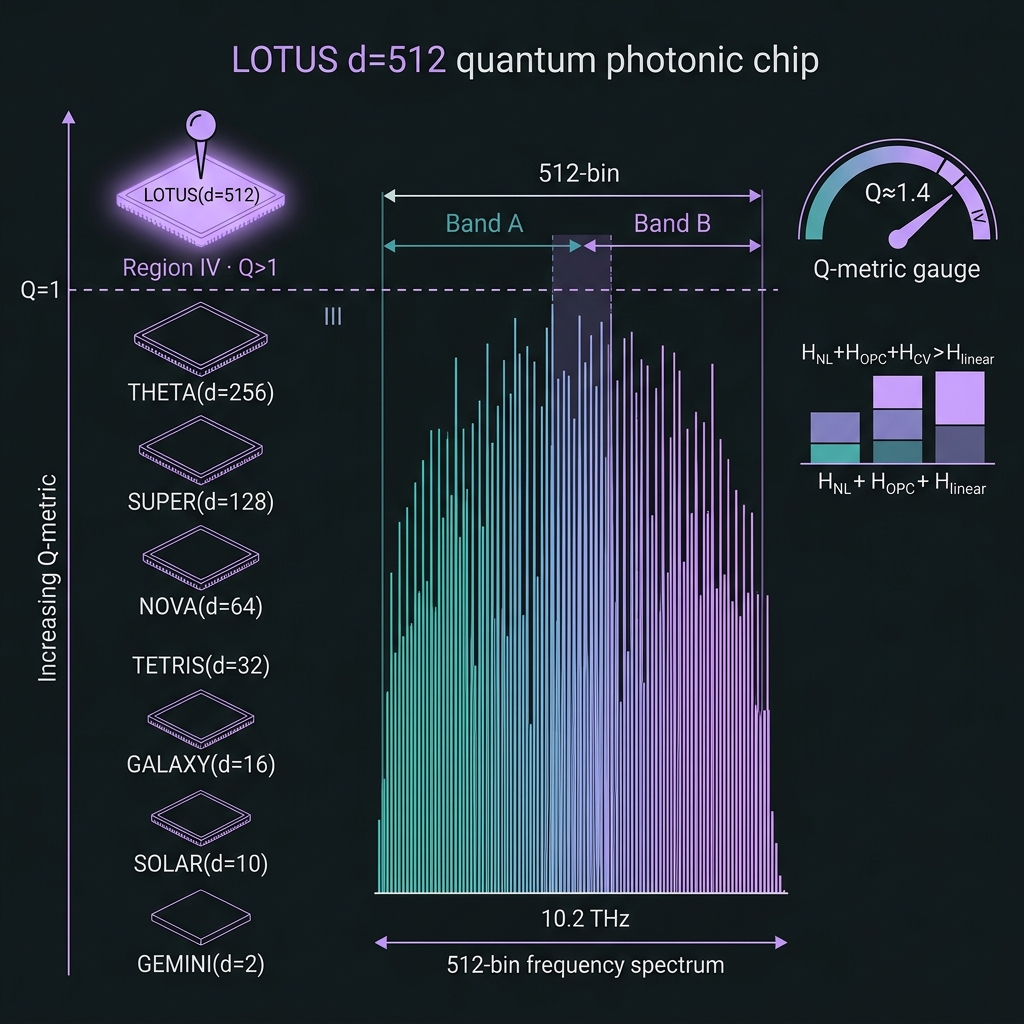 L-01 · L-02
Extreme coherent spectral machine
S71 — Region IV apex and THETA→LOTUS discontinuity.
QUASAR ladder terminus
NOVA → SUPER → THETA → LOTUSField-computing regime — not linear circuit + hygiene
→THETA (d=256, Region III) sits at Q ≈ 1 — linear and nonlinear Hamiltonians comparable. LOTUS doubles dimension while compressing Δf (25→20 GHz), pushing Bcomb from 6.38 THz to 10.2 THz. OPC single-band margin collapses to ~1.2× — split-band OPC mandatory.
Hero claim: LOTUS is where conjugation, squeezing, and χ⁽³⁾ interaction are co-equal with routing. Engineering center of gravity is CV stabilization across 261,632 phase relationships on a 10.2 THz manifold — not GFADD/GFMUL gate depth.
B_comb / B_OPC ≈ 10.2/12 ≈ 0.85 → split-band @ Δf_split ≈ 20 GHz bands
THETA → LOTUS discontinuity
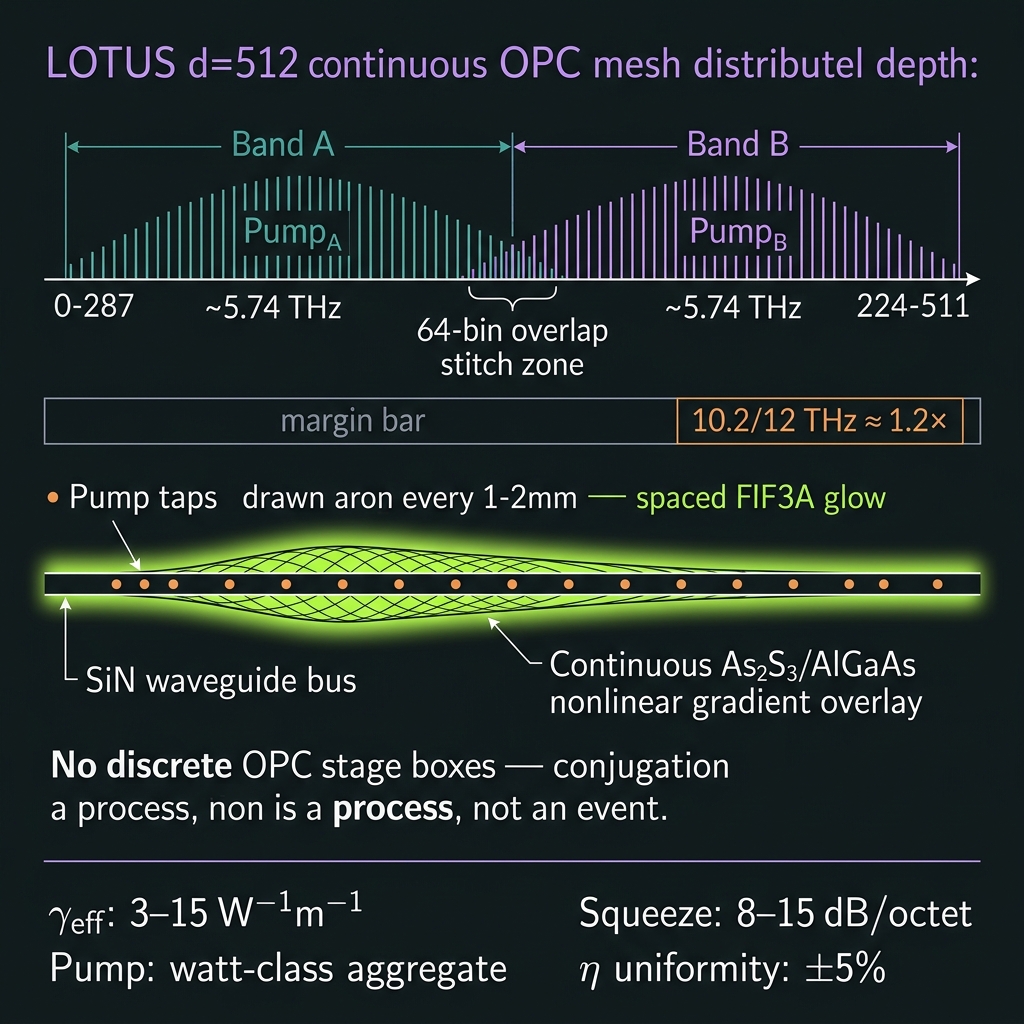
→At LOTUS, discrete OPC stages (every M gates) are insufficient — the chip requires distributed continuous conjugation along the waveguide: OPC is a process, not an event.
How we do it: Define continuous spectral manifold; deploy split-band distributed OPC; mandate CV squeeze mesh; replace brute calibration with field-theoretic tomography; gate public claims on T-THETA-01 and T-LOTUS-α.
| Metric | THETA | LOTUS | Ratio |
|---|---|---|---|
| Bits / photon | 8 | 9 | 1.125× |
| Phase pairs N(N−1) | 65,280 | 261,632 | 4× |
| FWM pathways | ~16.7M | ~134M | 8× |
| Bcomb | 6.38 THz | 10.2 THz | 1.6× |
| OPC margin | ~1.9× | ~1.2× split-band | critical |
- Hlinear — SiN backbone, minimal MZI depth → subdominant
- HNL — continuous χ⁽³⁾ mesh, ~134M FWM channels → dominant
- HOPC — split-band distributed conjugation → co-dominant
- HCV — mandatory multi-quadrature squeeze mesh → co-dominant
Target Q ≈ 1.2–1.8 — inside Region IV (>1). LOTUS is a stabilized nonlinear field, not a QFP-first processor.
Continuous spectral manifold
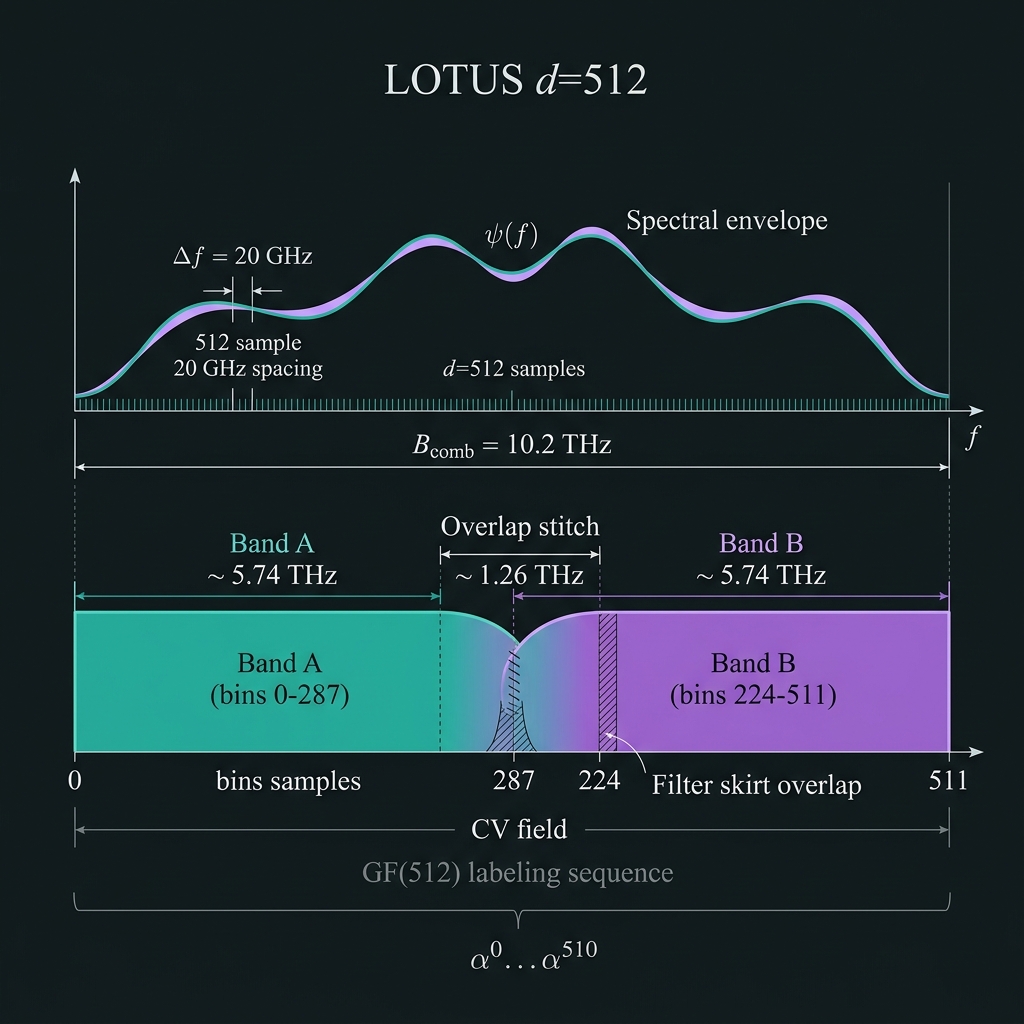
S72 — 512-sample field at Δf = 20 GHz across 10.2 THz.
Single-photon (or sub-shot-noise field) state: |ψ⟩ = Σk=0511 ck|fk⟩ with Σ|ck|² = 1. At LOTUS scale, the discrete sum approximates a continuous spectral envelope ψ(f):
ψ(f) ≈ Σ_k c_k · s(f − f_k)     s(·) = filter shape, width δf

GF(512) ≅ GF(2)[x]/(p(x))   degree-9 primitive (fuse map TBD)
|f_k⟩ ↔ α^k   for k = 0…510 ;  |f_511⟩ guard/monitor

FWM pathways ≈ d²(d−1) = 512² × 511 ≈ 134M
Region IV interpretation: Gates act on ψ(f) via nonlinear Hamiltonians (χ⁽³⁾, OPC, squeeze) more often than via sparse SU(512) permutations. The encoding object is the field, not the symbol.
Band A: bins 0–287   (~5.74 THz)   OPC mesh A
Band B: bins 224–511 (~5.74 THz)   OPC mesh B
Overlap: bins 224–287 (~1.26 THz)  stitch zone
Stitching maintains 261,632 pairwise relationships across band boundaries — the hardest encoding physics problem on LOTUS.
Critical honesty: GF(512) arithmetic is a readout/ECC convention applied after CV projection — not native gate algebra. Bin index k is not field addition.
How we do it: Fix Δf = 20 GHz per WS13-MANIFEST; design super-Gaussian filters targeting δf ≈ 12 GHz; simulate 134M FWM pathways for pump null schedules; map GF(512) fuse polynomial at ECC layer only; validate manifold orthogonality via process tomography on d=128 test vehicle (T-LOTUS-ENC) before full 512.
 L-03 · L-04
GF structure secondary to CV stabilization
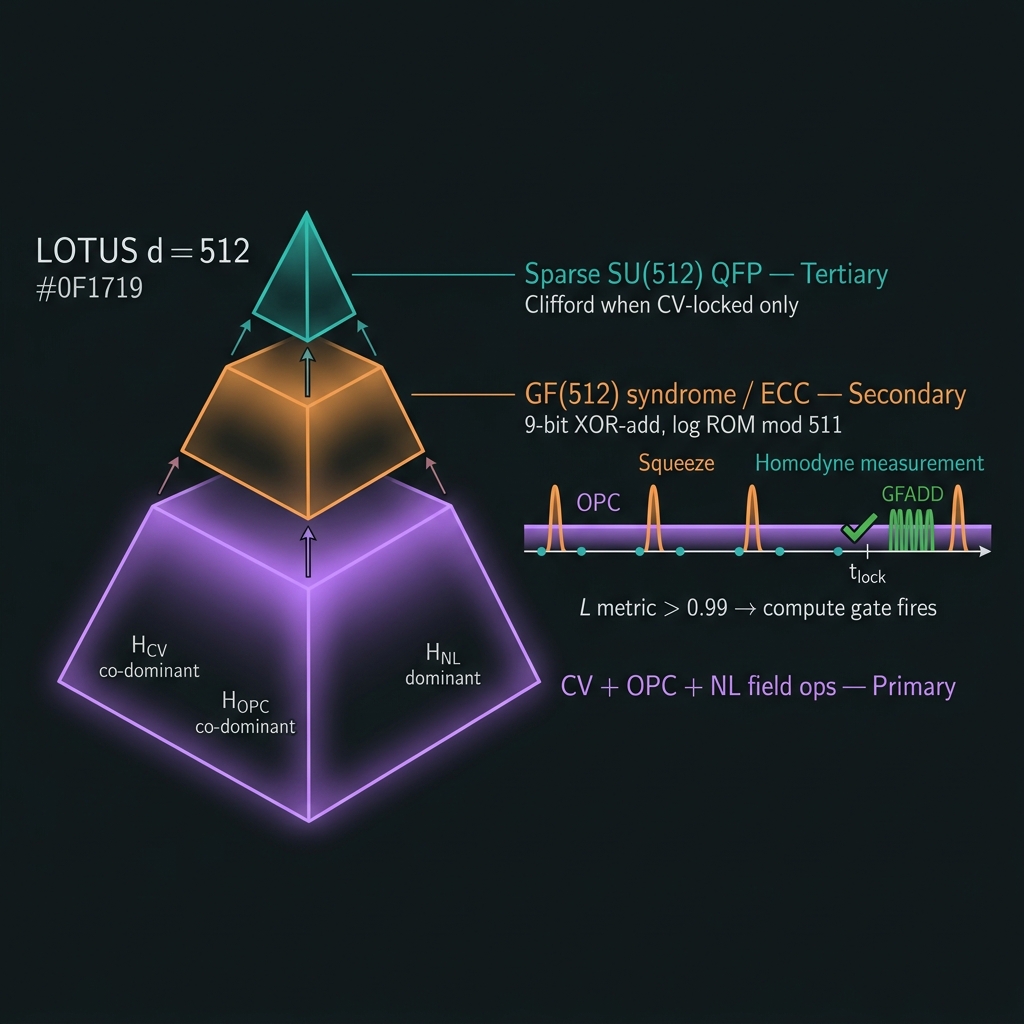
S73 — compute hierarchy inverted at Region IV.
Primary:   H_CV + H_OPC + H_NL  →  field evolution
Secondary: GF(512) ISA           →  syndrome, ECC
Tertiary:  SU(512) QFP           →  sparse Clifford when CV-locked
Gate on LOTUS = maintaining a target CV manifold under 134M parasitic couplings — not applying a unitary matrix in SU(512).
GFADD | Field add — XOR on 9-bit poly | FPGA + EOM mask |
GFMUL | Log ROM mod 511 + antilog | ~512×9 BRAM |
X₅₁₂ | Cyclic bin permutation | QFP when locked |
Z₅₁₂ | Phase twist on subset | EOM phase bus |
F₅₁₂ | DFT₅₁₂ basis change | avoid in v1 |
L = 1 − ⟨Δφ²⟩ / φ_budget     over witness pairs
Computational gate succeeds when L > L_thresh (e.g. 0.99) BEFORE GF syndrome extraction
Stages: (1) continuous OPC flow → (2) squeeze mesh homodyne → (3) witness tomography → (4) optional projection → (5) GFADD/GFMUL on syndrome only. Full SU(512) Reck (~130k cells) rejected for production.
How we do it: Specify CV lock protocol with witness pairs and homodyne thresholds; freeze Tier-B GF ROM (GFADD/GFMUL only); compile sparse Clifford X₅₁₂/Z₅₁₂ as post-lock microprograms; measure success by L metric, not process fidelity F_ρ alone. Public language: "GF(2⁹) algebraic control layers" — never "native GF quantum gates."
 L-05 · L-06
Ultra-stable comb + active feedback
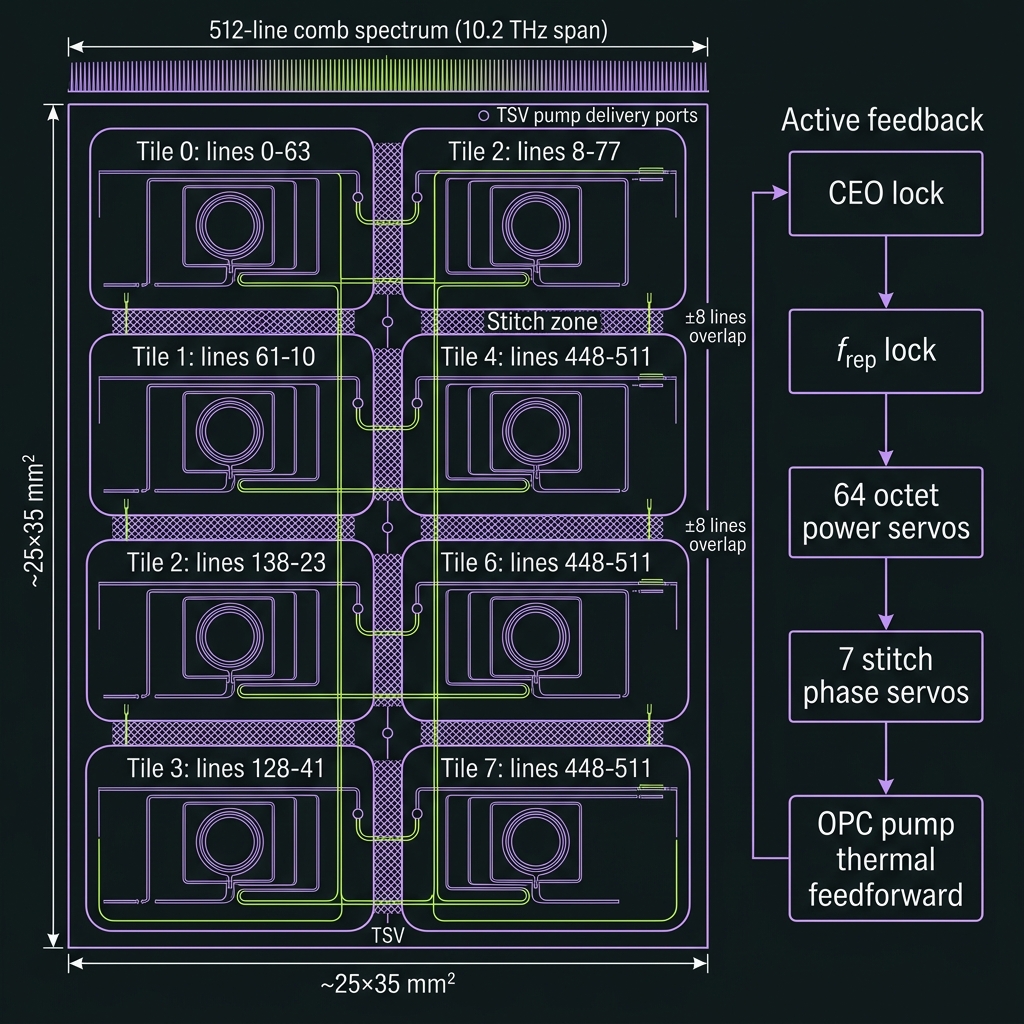
S74 — 8×64 octet tiling across octave-class span.
Tile 0: lines 0–63    → Tile 7: lines 448–511
Stitch: overlap ±8 lines between adjacent tiles
Lock: common CEO + 20 GHz rep reference

Pump_A center: f_c − 2.5 THz    span ~6 THz   (Band A OPC)
Pump_B center: f_c + 2.5 THz    span ~6 THz   (Band B OPC)
Overlap zone: shared lines 240–272 for stitch
- Si₃N₄ — ultra-low loss backbone, ring resonators (0.05 dB/cm class)
- TFLN — full-tile EO trim, >150 GHz BW per tile
- As₂S₃ / AlGaAs — continuous nonlinear overlay mesh
- TSV pumps — multi-tile pump delivery roadmap
- Layer 0 — f_rep @ 20 GHz; f_CEO via f-2f (<1 mrad drift)
- Layer 1 — 64 octets × 8 lines; ±0.3 dB uniformity @ 1 kHz
- Layer 2 — cross-tile stitch; φ_stitch < 0.05 rad to-be-tested
- Layer 3 — predictive heater cancel during OPC duty roadmap
512 + 16 guard lines; tile bypass fuse for bad 64-line tile; software remap reflows GF label → good bins. Minimum viable: 384 lines (6 tiles) degraded mode roadmap. Footprint ~25×35 mm² exceeds single reticle — multi-die on interposer likely.
How we do it: Scale G46 64-line tile to 8-tile array; implement G47 hierarchical lock extended to 512 lines; bond TFLN per tile; deposit continuous As₂S₃ mesh per S83; wafer test 512-line spectrum + ±0.3 dB uniformity (T-LOTUS-SRC). Label 512-line integrated comb to-be-tested until signoff.
 L-07 · L-08
512-channel at physical limits
S75 — hierarchical octet forest; project-then-detect mandatory.
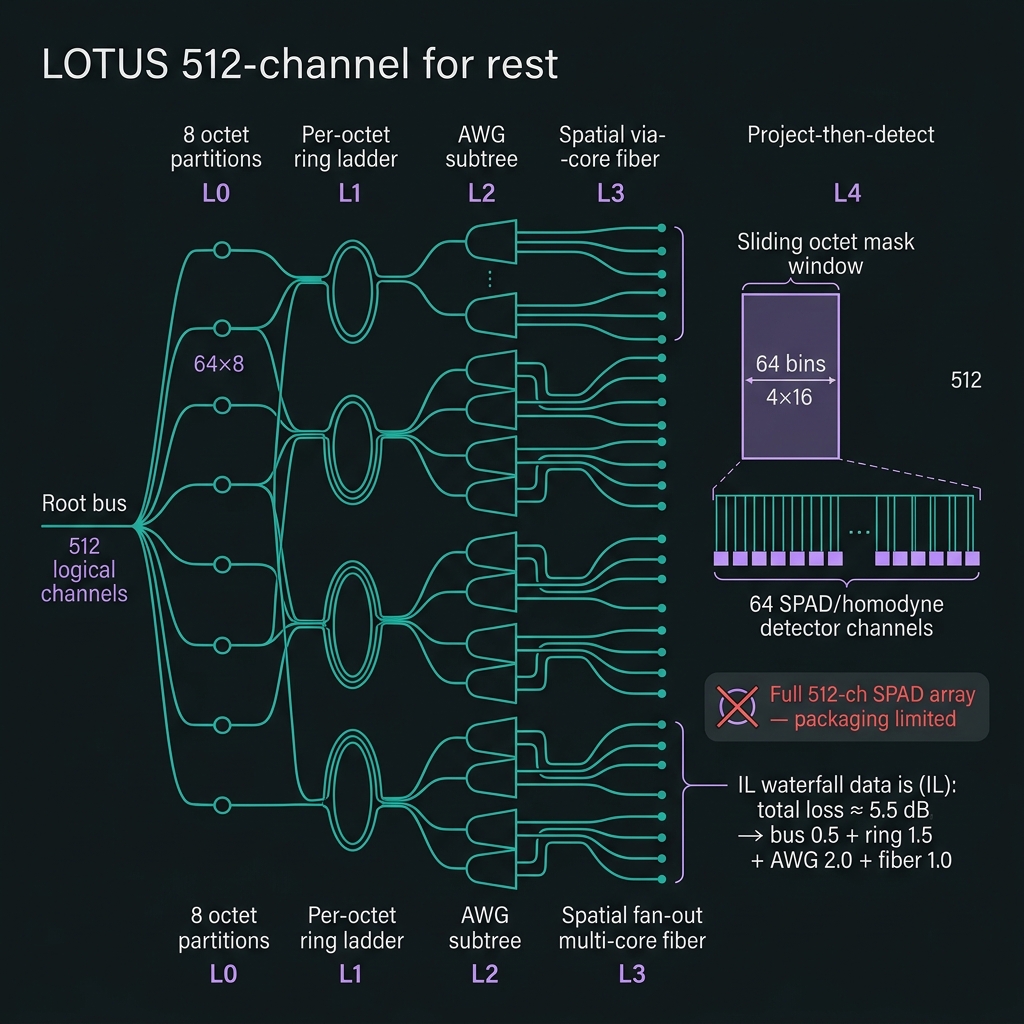
512-channel spectral routing exceeds practical AWG demux resolution. LOTUS routes via hybrid hierarchical fan-out, accepts partial projective readout, and treats routing IL as a CV noise source corrected by continuous OPC — not by re-demuxing every cycle.
| Tier | Mechanism | Channels |
|---|---|---|
| L0 | Octet partition (64×8) | 512 logical |
| L1 | Ring ladder per octet | 64/octet |
| L2 | AWG subtree 4×16 per octet | 32 AWG units |
| L3 | Spatial fan-out (multi-core fiber) | Parallel octets |
| L4 | Project-then-detect | Non-comp bases |
| Octet bus coupling | 0.5 dB |
| 64-ring ladder | 1.5 dB |
| 4×16 AWG | 2.0 dB |
| Packaging fiber | 1.0 dB |
| Total | ~5.5 dB |
Loss drives heralded erasure + digital QEC — not OPC-correctable. Full 512-ch simultaneous SPAD array is packaging-limited.
How we do it: Partition 512 → 8×64 octets; deploy 32× (4×16 AWG) subtrees; calibrate 512×512 leakage matrix at fab test; implement project-then-detect firmware with octet mask rotation (B09); align split-band routers with stitch overlap bins 240–272. Never claim "512-ch simultaneous SPAD readout" on v1.
 L-09 · L-10
261,632 phase relationships
S76 — ChiL⁺ hierarchical field tomography at the physical limit.
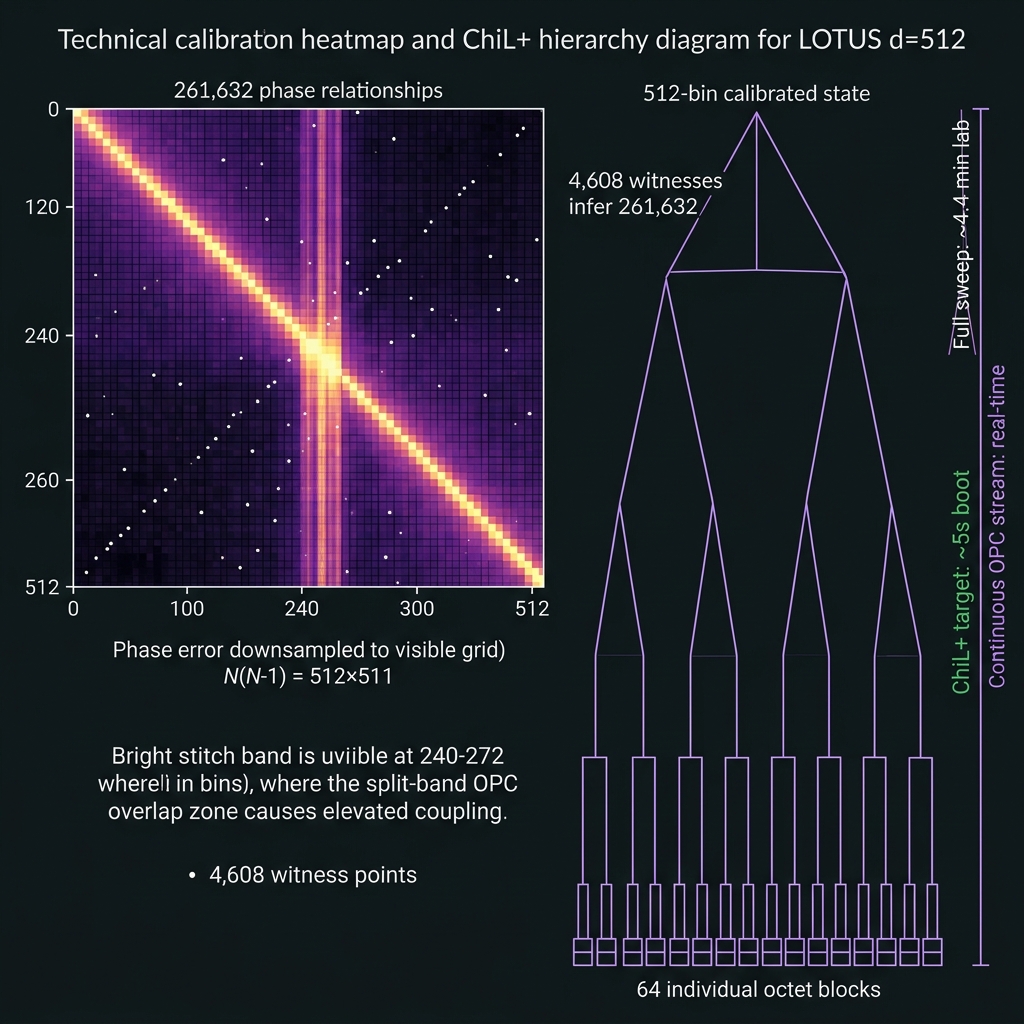
Directed pairs:     N(N−1) = 512×511 = 261,632
Undirected pairs:   N(N−1)/2       = 130,816
QFP cells (est.):   ~N²/2          ≈ 130,816

NOVA: 4,032 · THETA: 65,280 · LOTUS: 261,632
Target phase accuracy < 0.03 rad per pair for CV lock — tighter than Region I because 134M FWM pathways amplify φ errors.
- L0 — Global comb lock (f_rep, f_CEO)
- L1 — Octet block lock (64×64 = 4,096 pairs/octet)
- L2 — ChiL tree merge → full 512 (~4,608 witnesses)
- L3 — Split-band stitch (overlap bins 240–272)
- L4 — Continuous OPC-as-sensor stream claim
- L5 — Field tomography inference (sparse → full 261k)
| Full 261,632 sweep | ~4.4 min @ 1 ms/meas | lab only |
| Full ~130k cell sweep | weeks | no |
| ChiL⁺ witness + infer | ~5,000 → ~5 s boot | target |
| Continuous OPC stream | real-time | target run |
How we do it: Boot CEO → rep → 8-tile stitch → octet power; ChiL⁺ spanning tree on 512 nodes + FWM-graph samples; inference engine solves ~130k cell θᵢ from ~5k witness Vij; kHz fast loop on stitch pairs; acceptance: witness pairs < 0.03 rad, CV tomography L > 0.99 (T-LOTUS-CAL).
 L-11 · L-12
Distributed continuous process
S77 — split-band Δf=20 GHz; OPC is a process, not a stage.
Conjugation flows with the signal — no "OPC off" compute windows. The waveguide is the OPC lattice. Distributed As₂S₃/AlGaAs segments along Ltotal ~ 10–30 cm; pumps always partially on — duty modulated, never zero.
| Factor | THETA | LOTUS |
|---|---|---|
| OPC model | Continuous onset | Fully continuous mesh |
| Bcomb | 6.38 THz | 10.2 THz |
| OPC margin | ~1.9× | ~1.2× split-band |
| Phase pairs | 65,280 | 261,632 |
| CV squeeze | Mandatory mesh | Co-dominant HCV |
- γ_eff: 3–15 W⁻¹m⁻¹ segments
- Pump power: watt-class aggregate
- Squeeze θ per octet: 8–15 dB target
- η uniformity: ±5% across all bins (acceptance test)
- Raman-null: 7.4 THz detuning per band
How we do it: Fabricate continuous As₂S₃ mesh per S83; deploy dual pump system Band A/B with overlap stitch; derive pumps from 512-line comb with 7.4 THz Raman filter; integrate 8-octet squeeze mesh with homodyne feedback; run continuous OPC-as-sensor feeding ChiL⁺; measure T-LOTUS-OPC on 128-bin vehicle first.
 L-13 · L-14
Field-theoretic treatment
S78 — CV first, GF(512) syndrome second; OPC complements digital QEC.
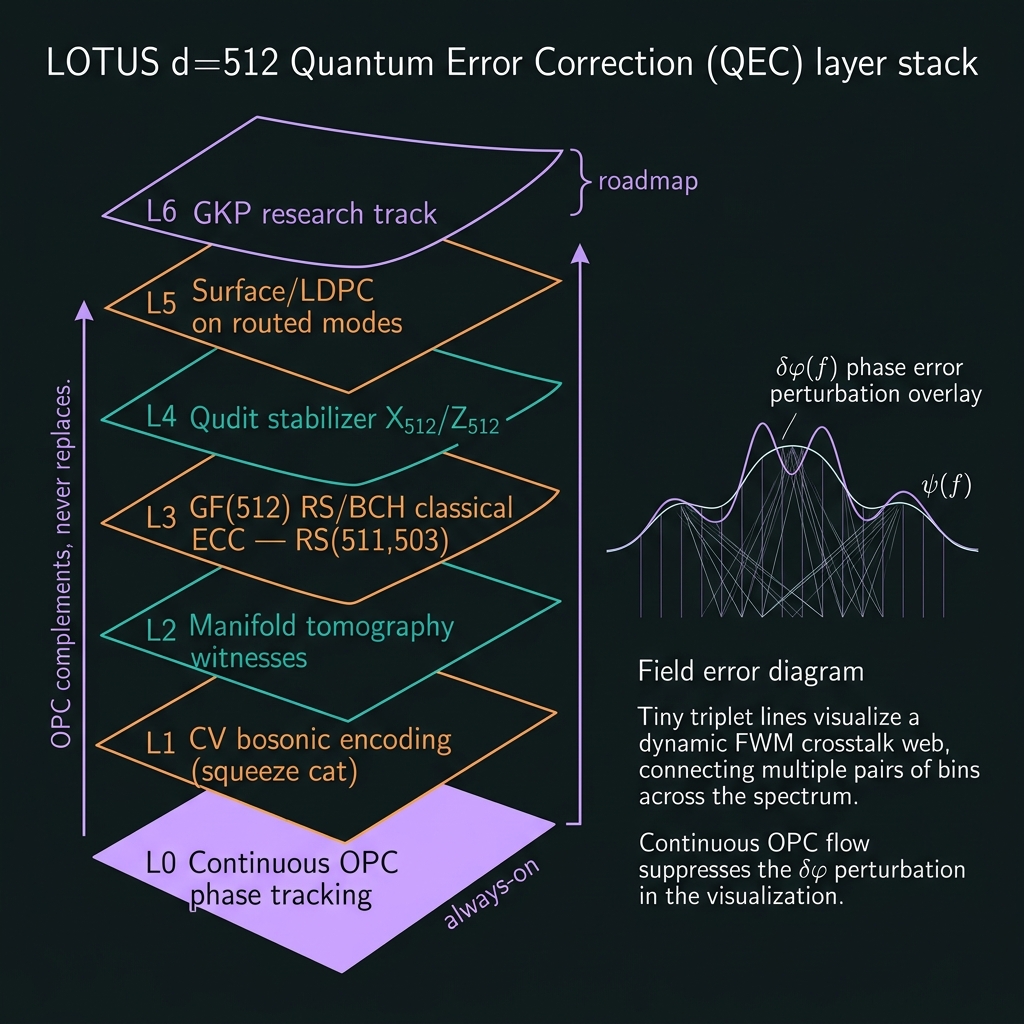
L0  Continuous OPC phase tracking
L1  CV bosonic encoding (squeeze cat)        [roadmap]
L2  Manifold tomography witnesses
L3  GF(512) RS / BCH classical ECC         RS(511,503) native 9-bit
L4  Qudit stabilizer X_512 / Z_512
L5  Surface / LDPC on routed modes
L6  GKP research track                     [roadmap]
| Error class | Primary handler |
|---|---|
| Dephasing / φ drift | Continuous OPC + CV |
| Amplitude loss | Heralded erasure + LDPC |
| Pauli on projected symbol | GF(512) stabilizer / RS |
| CV quadrature noise | Bosonic QEC / GKP roadmap |
| Non-Gaussian NL drift | Field tomography + reset speculative-framework |
OPC (L0) lowers effective dephasing pZ,raw ~ 35% @ depth 1000 → pZ,eff ~ 1–5% with continuous OPC model. Surface code threshold ~1% requires εeff < 10⁻² — LOTUS does not claim fault tolerance without T-LOTUS-QEC-SIM.
134M FWM pathways introduce correlated error channels — structured LDPC or bosonic codes required.
How we do it: Simulate εeff with continuous OPC + IL + projection; specify RS(511,503) as default classical ECC; implement GF syndrome firmware (GFADD/GFMUL on extracted symbols); deploy homodyne feedback as L1 CV correction; pair surface/LDPC on routed octet modes — erasure-aware. Public language: "OPC-assisted CV stabilization complements digital QEC" — mandatory.
 L-15 · L-16
Long-term research horizon
S79 — vision anchor, not shipping roadmap.
Application taxonomy
Tier A research · Tier B reduced vehicles · Tier C visionNonlinear optical field simulation
→LOTUS manifold as analog simulator for coupled-mode systems at 10.2 THz resolution. Native 134M FWM pathways are feature, not bug, when simulating coupled fields. speculative-framework
Extreme-bandwidth spectral processing
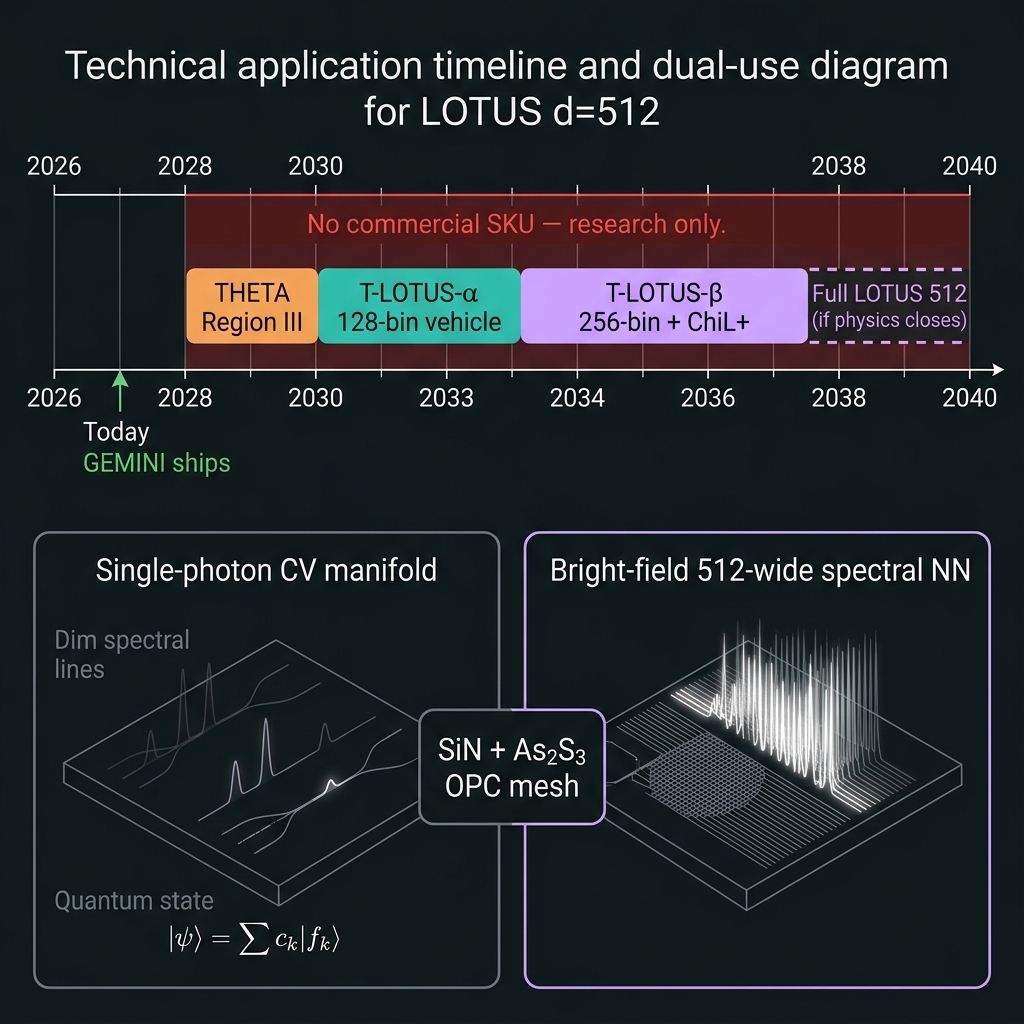
→512 parallel frequency samples @ 20 GHz enable O(N) spectral convolutions via χ⁽³⁾ mixing. Dual-use with OPC-stabilized photonic AI — same hardware, bright light = AI accelerator. roadmap
GF(512) coding-theoretic testbed
→RS(511,503) blocks at native 9-bit symbols — high-rate classical ECC and qudit stabilizer experiments. Secondary narrative only — never lead with GF arithmetic. designed/target
Field-programmable optical computer
→Reconfigure γ(z), pump schedule, squeeze mesh to solve instance-specific Hamiltonians. Requires full d=512 Region IV proven. speculative-framework
| T-THETA-01 | Region III physics credible |
| T-LOTUS-α (128-bin) | Split-band + continuous OPC story |
| T-LOTUS-CAL | 261k-scale calibration simulated |
| T-LOTUS-128 | Reduced demo publications |
| T-LOTUS-512 | Full vision (unlikely <2035) roadmap |
2028–2030   THETA Region III program
2030–2033   T-LOTUS-α 128-bin vehicle
2033–2038   T-LOTUS-β 256-bin + ChiL⁺
2038+       Full LOTUS 512 research (if physics closes)   [roadmap — not commitments]
 L-17 · L-18
What LOTUS is made of
d=512 · GF(2⁹) · Region IV · ~25×35 mm² multi-tile die · Δf=20 GHz · Bcomb=10.2 THz · 512-bin research horizon
Δ Delta — what changes at LOTUS
- Rack-scale multi-tile architecture — largest footprint in the QUASAR ladder
- Split-band OPC mandatory — Band A (bins 0–287) + Band B (bins 224–511), overlap stitch zone bins 224–287 (~1.26 THz). Smallest margin at ~1.2×
- TSV pump delivery across tiles — through-silicon vias for multi-tile pump distribution
- Multi-core fiber spatial fan-out for 512-channel I/O
- ~130,816 QFP cells — largest estimated cell count in the family
- Tri-band soliton comb — 8×64 octet tiling with stitch zones
Bill of Materials
| Subsystem | Components | Source | Status |
|---|---|---|---|
| Photonics | 512-line microcomb — 8×64 octet tiling w/ stitch zones | LIGENTEC | speculative |
| Ring resonators Si₃N₄ ultra-low loss 0.05 dB/cm | LIGENTEC | roadmap | |
| 32 × (4×16 AWG) subtrees — spectral de-mux | in-house | speculative | |
| 64-ring ladder per octet | in-house | speculative | |
| ~130,816 QFP cells (estimated) | in-house | speculative | |
| Multi-core fiber spatial fan-out | custom | roadmap | |
| Super-Gaussian filters ~12 GHz δf | in-house | speculative | |
| Active | TFLN full-tile EO trim — >150 GHz BW per tile | custom | speculative |
| Continuous As₂S₃ / AlGaAs nonlinear overlay mesh | custom | speculative | |
| TSV pumps — multi-tile pump delivery | in-house | speculative | |
| 64 octet power servos | in-house | speculative | |
| 7 stitch phase servos | in-house | speculative | |
| OPC | Split-band mandatory — Band A: bins 0–287 (~5.74 THz), Band B: bins 224–511 (~5.74 THz) | in-house | speculative |
| Overlap stitch zone: bins 224–287 (~1.26 THz). OPC margin ~1.2× | in-house | speculative | |
| Detectors | SPAD / homodyne channels — 64 per octet mask rotation | custom | speculative |
| Electronics | Versal-class scheduler + multi-die ASIC set — rack-scale orchestration | Xilinx / custom | speculative |
| STM32H7 — housekeeping & servo control | ST | demonstrated | |
| Lasers | Santec TSL-570 — tunable seed | Santec | demonstrated |
| Menlo C-fiber — comb reference | Menlo | demonstrated | |
| Materials | Si₃N₄ ultra-low loss 0.05 dB/cm | LIGENTEC | roadmap |
| TFLN — >150 GHz BW | custom | speculative | |
| As₂S₃ / AlGaAs continuous nonlinear overlay mesh | custom | speculative |
Vertical integration stack
Rack-scale multi-tile architecture. Same control tier as THETA (Versal + multi-die ASIC) but expanded to rack-scale orchestration with TSV pump delivery across tiles and multi-core fiber spatial fan-out. Region IV research horizon — not a product commitment.
Where LOTUS sits
LOTUS is the apex of the QUASAR ladder — Region IV field-computing regime. THETA at Q≈1 is the last gate-locked balance; LOTUS crosses into Q>1 where CV + OPC + NL dominate. Not a product. GEMINI ships today.
Today's chip vs tomorrow's research horizon
GEMINI is the shipping STAR-PHASER reference SKU. LOTUS is the long-term QUASAR vision anchor — research partnership and diligence interest only.