Photonic Qudit Lineup Index
Eight gate-locked chip references on a single dimension ladder — not "different bases," but photonic qudit systems of dimension d in frequency-bin synthetic spectral space with OPC-assisted CV stabilization and GF(2m) algebraic control layers (SOLAR: structured 2×5 composite, ℤ₁₀, not a field). GEMINI is production-ready; all siblings are in development, research stage, or speculative-framework unless labeled.
Eight chips on the Q-metric rail
Q < 0.2 · STAR-PHASER
Linear QFP + OPC hygiene. Teal band. GEMINI → TETRIS. GALAXY rehearses QUASAR fab while staying below Q = 0.2.
0.2 ≤ Q < 1 · QUASAR hybrid
OPC + squeeze co-equal. NOVA opens the brand; SUPER hits crisis zone (~2.7× OPC margin).
Q ≈ 1 ± 0.1 · field balance
THETA: continuous OPC mesh, Δf = 25 GHz. Speculative-framework
Q > 1 · field-dominant
LOTUS: split-band OPC, CV-primary. Research horizon — not product (NS-08).
Master chip index
| Chip | Brand | d | Algebra | Region | Q (target) | Δf | Maturity | Page |
|---|---|---|---|---|---|---|---|---|
| GEMINI | STAR-PHASER | 2 | qubit / GF(2) dual-rail | I | ≪ 0.2 (~0.05) | — (path encoding) | Production-ready | chip-gemini.html → |
| SOLAR | STAR-PHASER | 10 | 2×5 composite · ℤ₁₀ | I | ≪ 0.2 (~0.08) | 50 GHz | In development | chip-solar.html → |
| GALAXY ★ | STAR-PHASER | 16 | GF(2⁴) | I | < 0.2 (~0.12) | 50 GHz | Design complete · QUASAR-transition prototype | chip-galaxy.html → |
| TETRIS | STAR-PHASER | 32 | GF(2⁵) | I | < 0.2 (~0.15) | 50 GHz | Design complete | chip-tetris.html → |
| — — — BOUNDARY Q = 0.2 · d = 64 brand transition TETRIS → NOVA — — — | ||||||||
| NOVA | QUASAR | 64 | GF(2⁶) | II | 0.2–0.6 (~0.35) | 50 GHz | In development · WS12 target | chip-nova.html → |
| SUPER | QUASAR | 128 | GF(2⁷) | II | 0.4–0.8 (~0.50) | 35 GHz | In development · advanced | chip-super.html → |
| THETA | QUASAR | 256 | GF(2⁸) | III | ≈ 1 (~1.0) | 25 GHz | Research stage · field computing | chip-theta.html → |
| LOTUS | QUASAR | 512 | GF(2⁹) | IV | > 1 (~1.4) | 20 GHz | Research horizon | chip-lotus.html → |
Canonical Δf / comb span table (S84): GEMINI N/A · SOLAR 450 GHz · GALAXY 750 GHz · TETRIS 1.55 THz · NOVA 3.15 THz · SUPER 4.45 THz · THETA 6.38 THz · LOTUS 10.2 THz. See QUASAR Framework §7 for full scaling-law detail.
STAR-PHASER vs QUASAR
STAR-PHASER
Region I · Q < 0.2 · linear circuit + OPC hygieneGEMINI
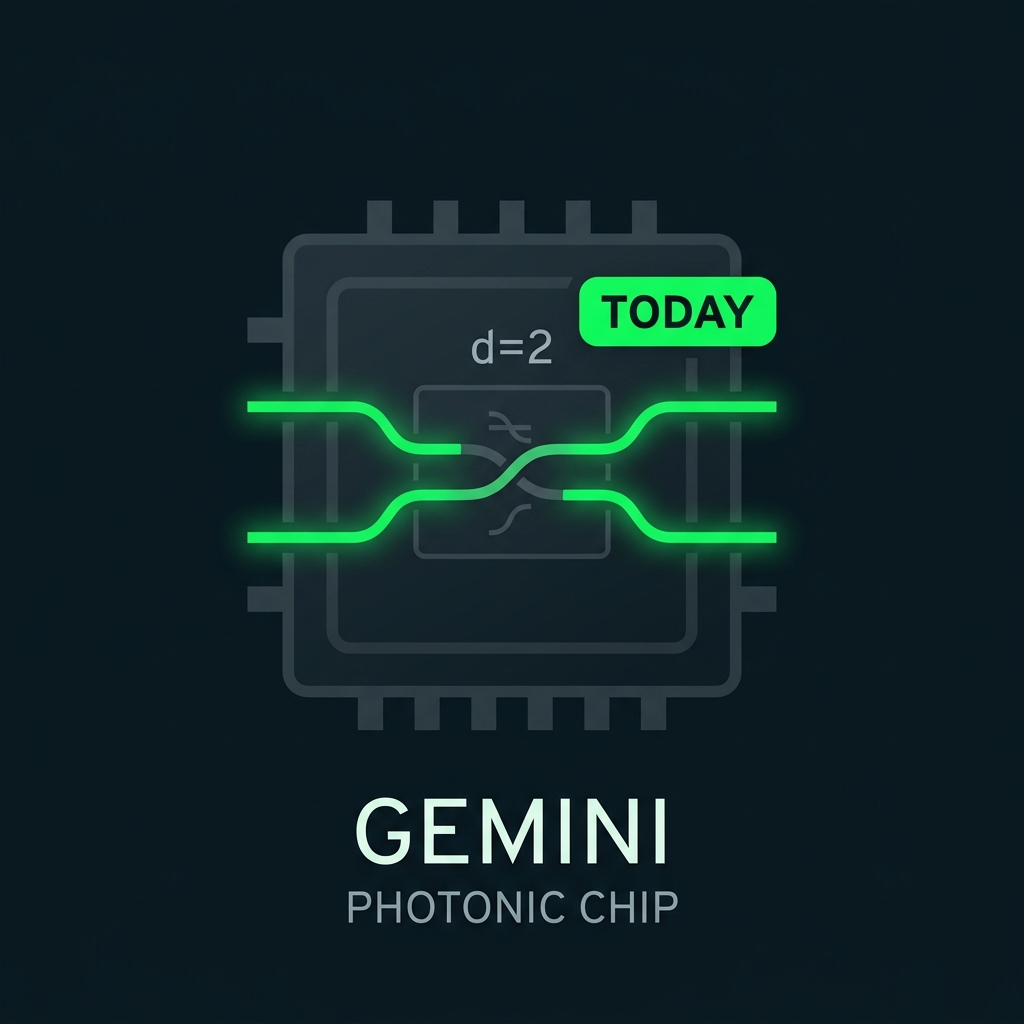
→Only v1 SKU. Dual-rail path qubit on an 8-mode Clements mesh with K=8/T=4 herald multiplexing and warm SPAD readout. The production-ready anchor every ladder sibling inherits its Si₃N₄ backbone from.
d=2 · GF(2) · SU(2) · Q ≪ 0.2 (~0.05) · Δf — (path encoding, no comb)
Memos S01–S10. Open GEMINI reference →
SOLAR
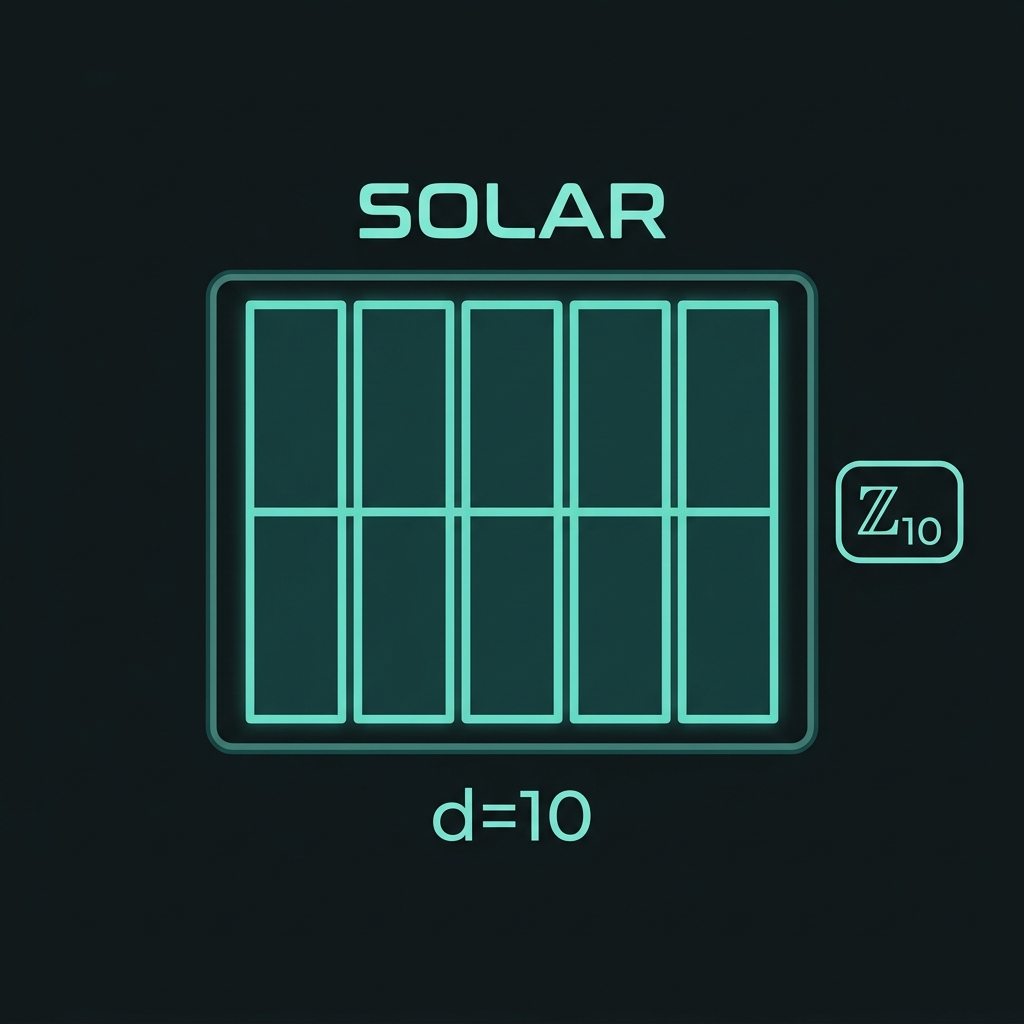
→Spectral decimal computing bridge — a structured 2×5 composite qudit running the DQFP/SDCLA decimal ISA. ℤ₁₀ ring arithmetic, not GF(10); algebraically a tensor-product space, not a field.
d=10 · 2×5 composite · ℤ₁₀ · Q ≪ 0.2 (~0.08) · Δf 50 GHz · Bcomb 450 GHz
Memos S11–S20. Open SOLAR reference →
GALAXY
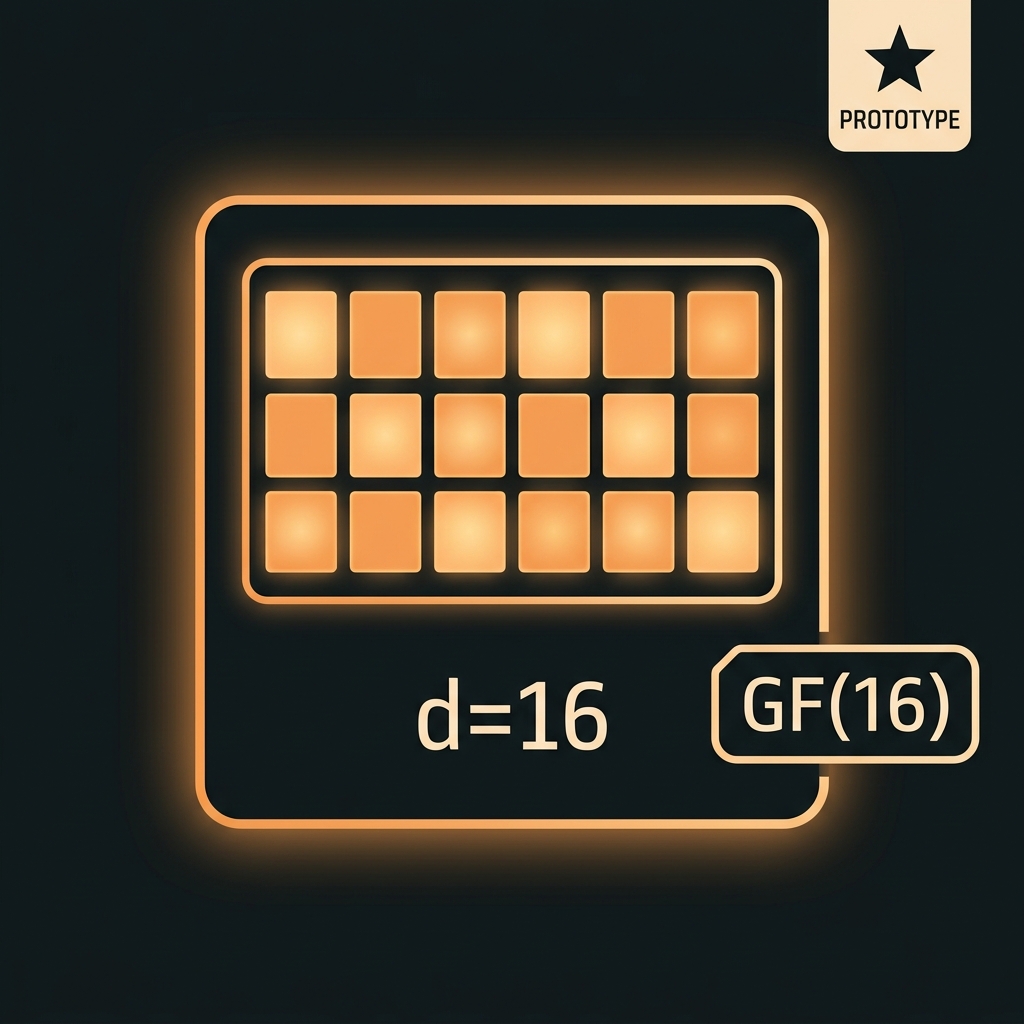
→First true finite-field architecture — GF(2⁴) with clean stabilizer compatibility. GALAXY is not QUASAR: it rehearses the L5 AlGaAs OPC mesh while staying safely in Region I. Passing the T-GALAXY gate authorizes the NOVA tape-out.
d=16 · GF(2⁴) · Q < 0.2 (~0.12) · Δf 50 GHz · Bcomb 750 GHz
Memos S21–S30. Open GALAXY reference →
TETRIS
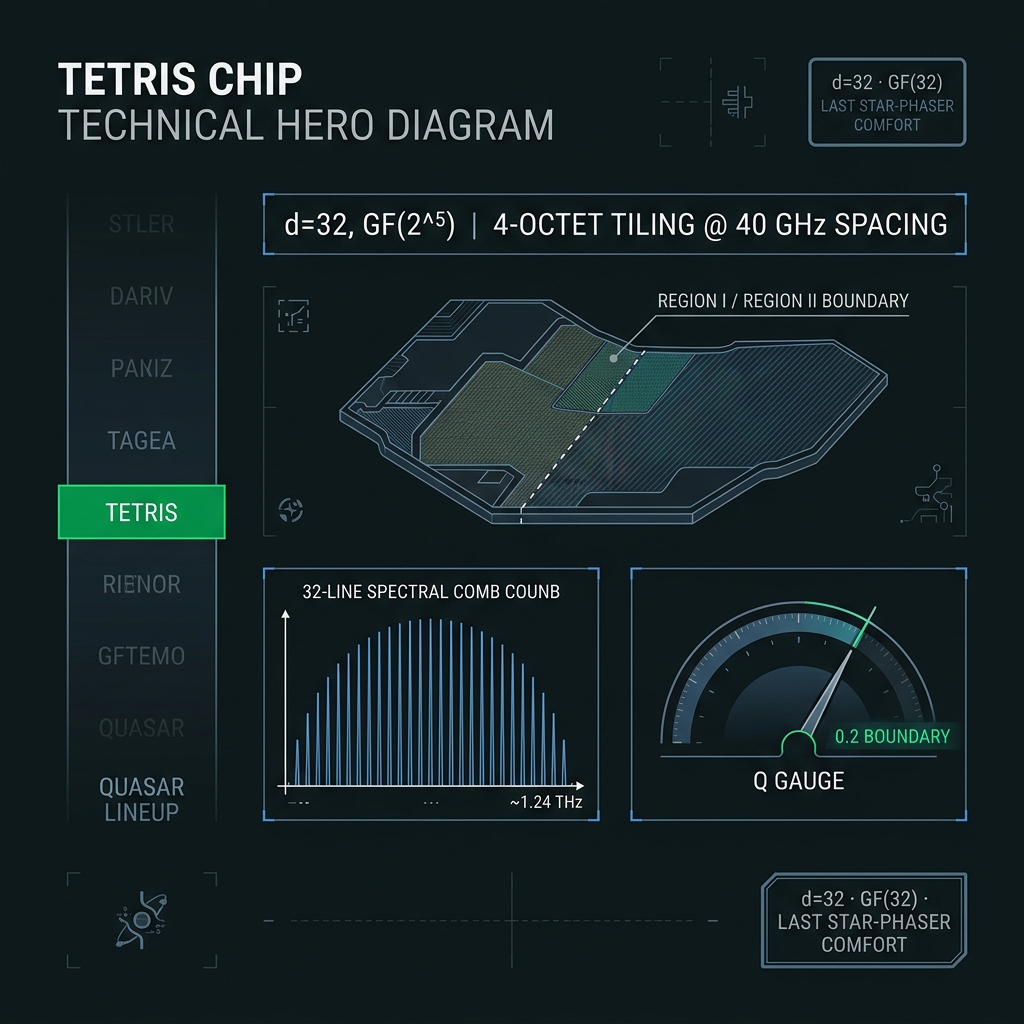
→Scaling stress test before the d=64 boundary — 5 bits/photon, 992 phase pairs, and the first place the AWG routing ceiling bites (failure Law IV). The last chip where independent calibration and linear optics still dominate.
d=32 · GF(2⁵) · Q < 0.2 (~0.15) · Δf 50 GHz · Bcomb 1.55 THz
Memos S31–S40. Open TETRIS reference →
QUASAR
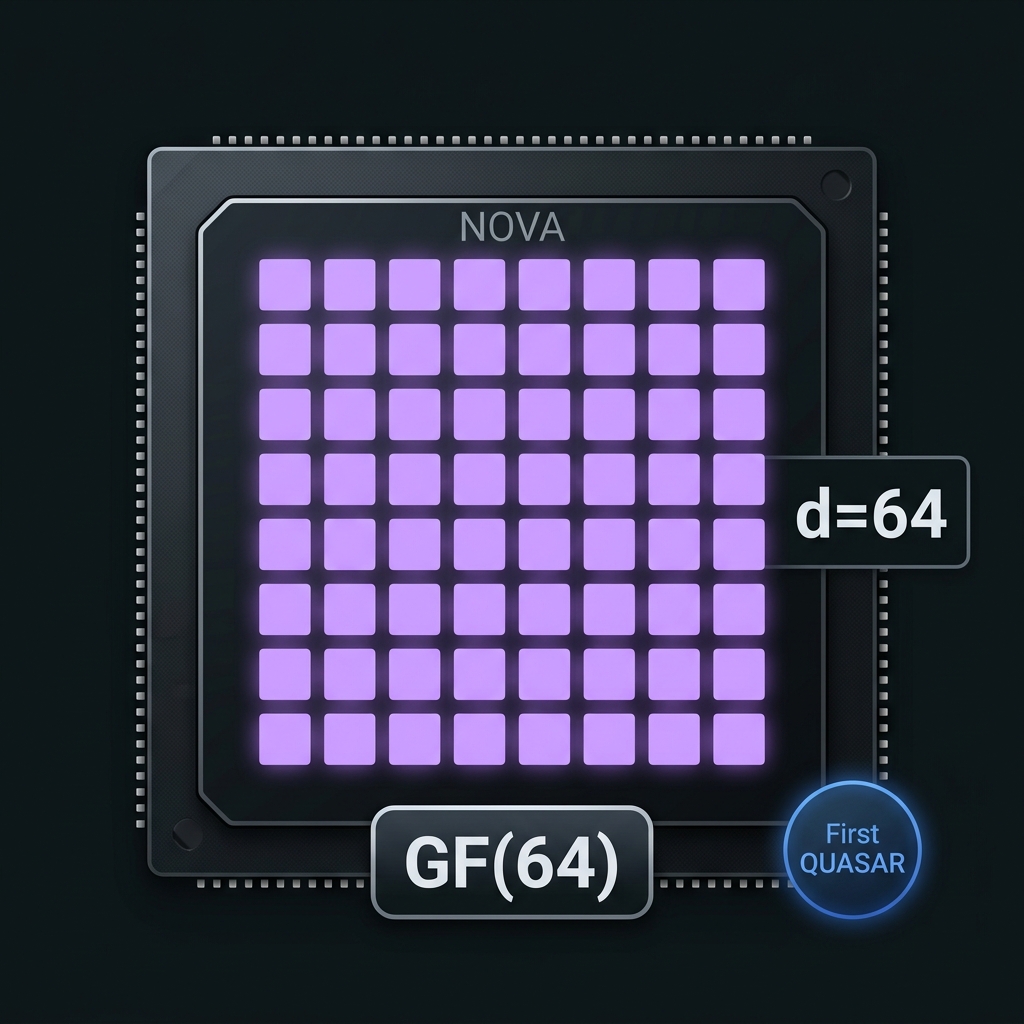
Region II+ · Q ≥ 0.2 · hybrid & field-dominantNOVA
→The brand opens at d=64. WS12 Rung 3 endpoint: 8×8 octet tiling, distributed OPC mesh, ~4× OPC margin. The sweet-spot candidate where Reed–Solomon coding becomes hardware-native.
d=64 · GF(2⁶) · Q 0.2–0.6 (~0.35) · Δf 50 GHz · Bcomb 3.15 THz
Memos S41–S50. Open NOVA reference →
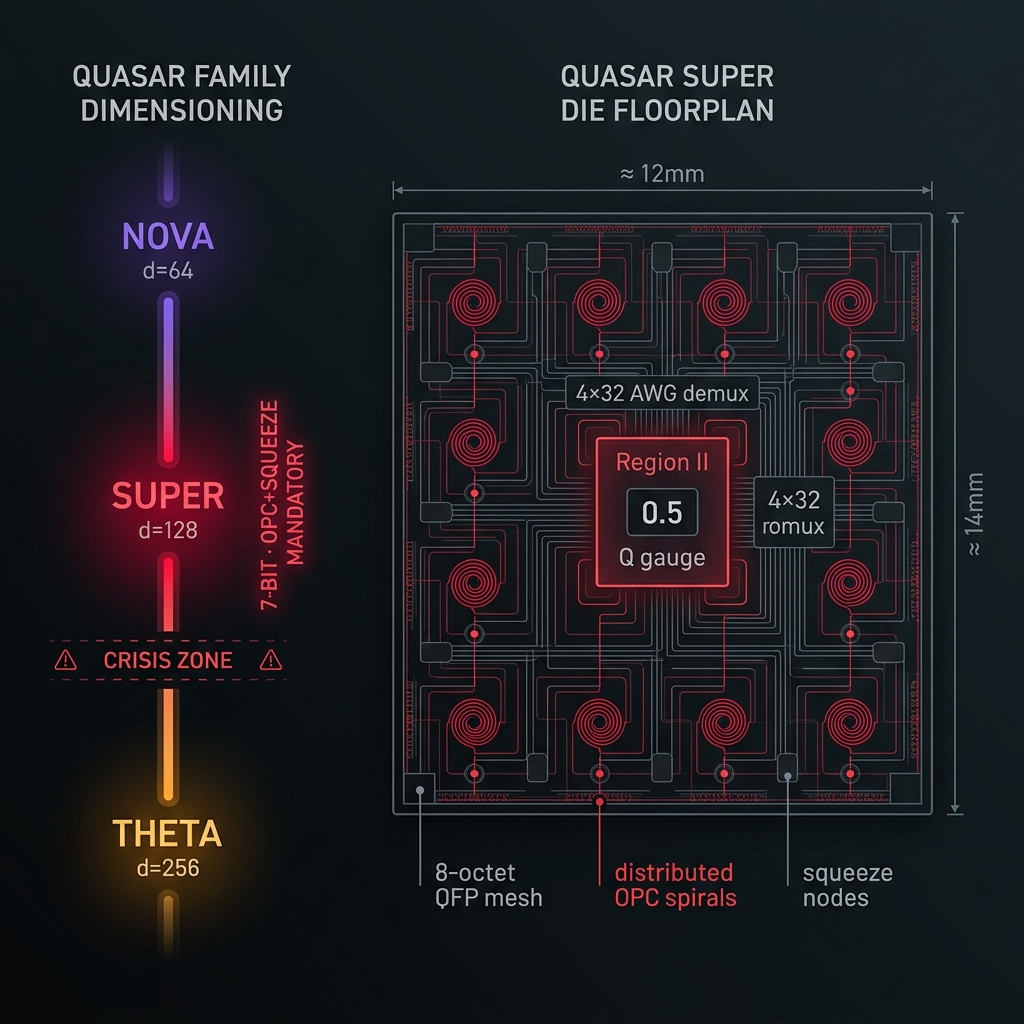
SUPER
→Where the linear paradigm cannot extrapolate: 16,384 phase pairs and ~2.7× OPC margin. OPC + squeezing become mandatory, not optional (NS-05) — the first true STAR-PHASER crisis.
d=128 · GF(2⁷) · Q 0.4–0.8 (~0.50) · Δf 35 GHz · Bcomb 4.45 THz
Memos S51–S60. Open SUPER reference →
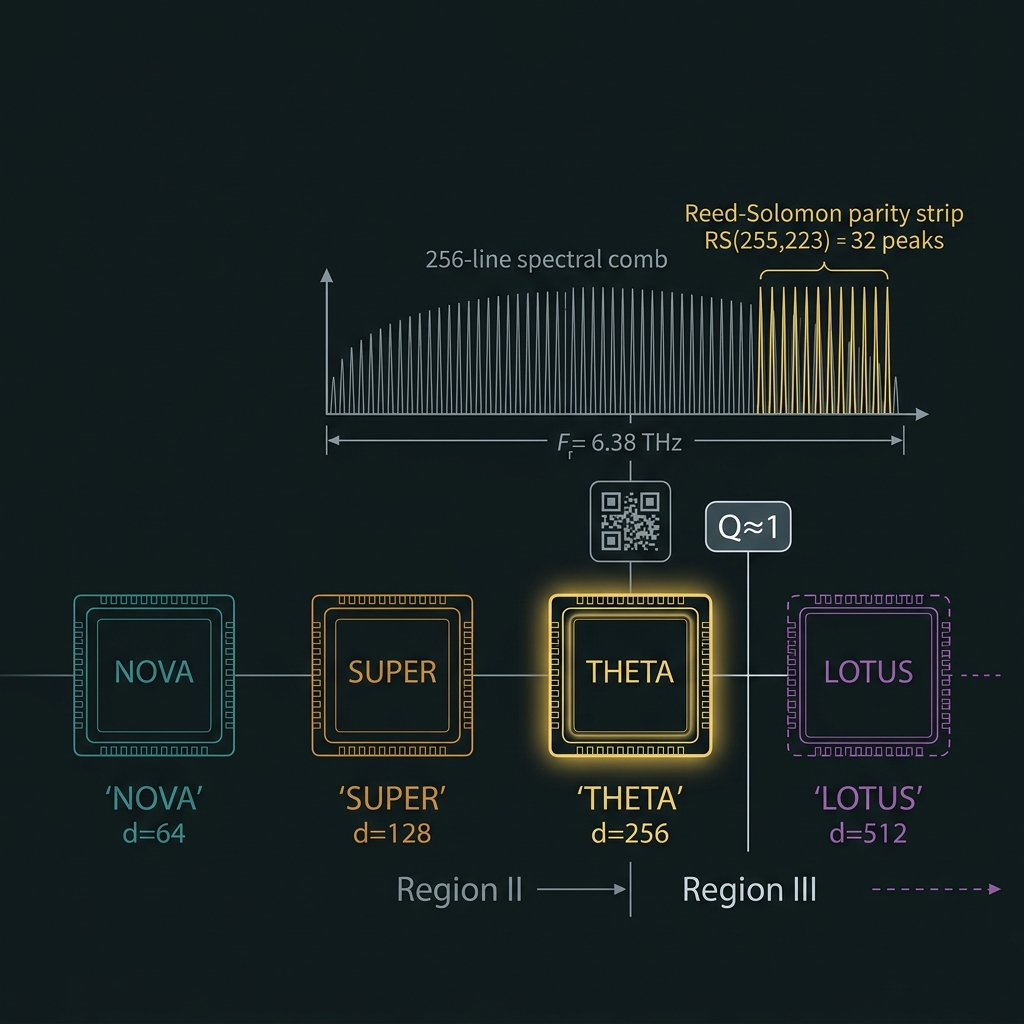
THETA
→First plausible field-computing architecture. Continuous OPC mesh, global φ₀ calibration, RS(255,223) hybrid classical–quantum stack — the telecom-native byte field at Region III balance. Speculative-framework
d=256 · GF(2⁸) · Q ≈ 1 (~1.0) · Δf 25 GHz · Bcomb 6.38 THz
Memos S61–S70. Open THETA reference →
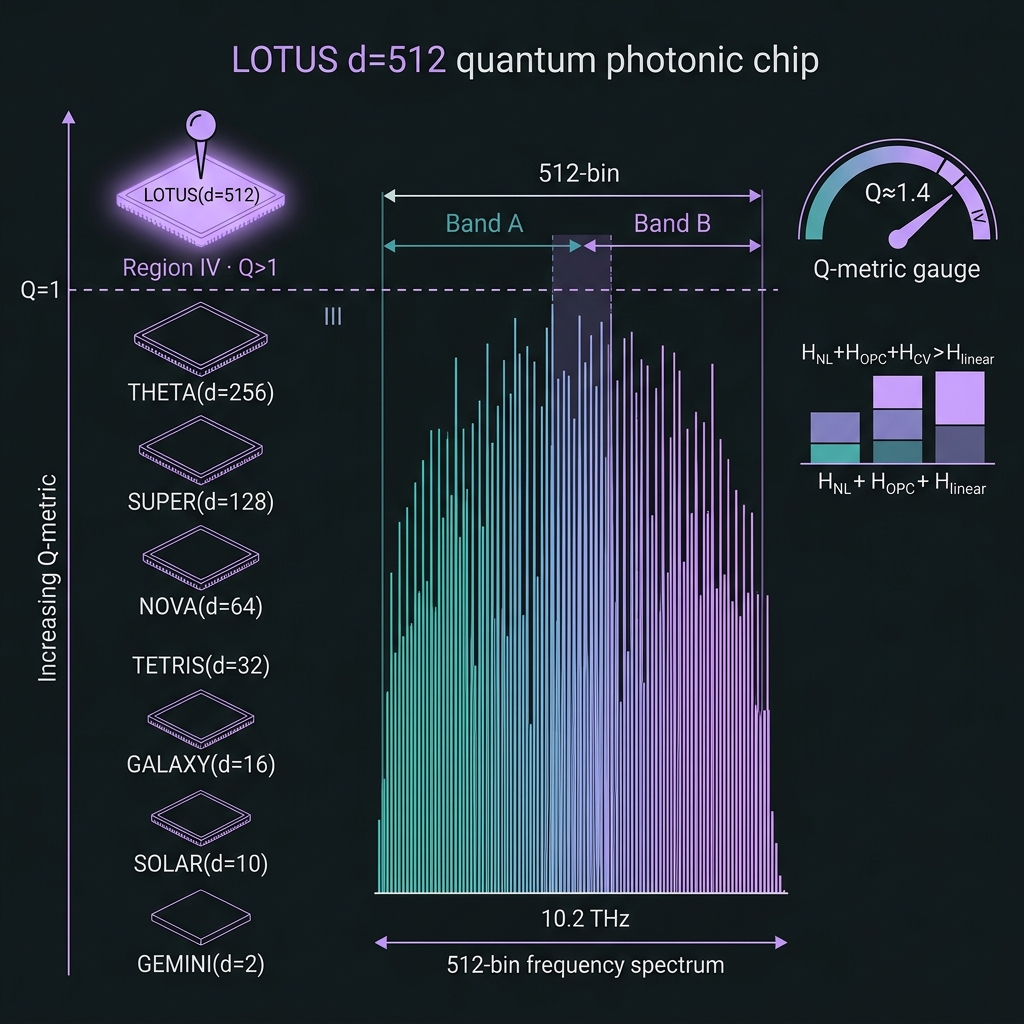
LOTUS
→Apex of the speculative framework: ~134M FWM pathways, split-band OPC, CV-primary stabilization — the system behaves as a continuous spectral manifold. Not a product (NS-08); research horizon only. Speculative-framework
d=512 · GF(2⁹) · Q > 1 (~1.4) · Δf 20 GHz · Bcomb 10.2 THz
Memos S71–S80. Open LOTUS reference →
Stability phase diagram
Brand transition (d=64)
TETRIS → NOVA. OPC margin ~4× at Δf=50 GHz. STAR-PHASER ends; QUASAR opens.
Crisis (d=128)
SUPER at Q≈0.5, 16k phase pairs, ~2.7× OPC margin. Linear paradigm cannot extrapolate.
Resolution → apex
THETA continuous OPC at Q≈1. LOTUS Region IV split-band OPC, CV-primary at d=512.
Scaling-law backbone
| # | Failure mechanism | Scaling law | First stress / fail | Mitigation | Crosses (chips) |
|---|---|---|---|---|---|
| I | Comb span vs OPC / platform band | Bcomb = (d−1)·Δf ≤ BOPC/mmargin | WARN SUPER (~2.7×); FAIL THETA @ Δf=50 GHz | Reduce Δf; split-band OPC (LOTUS) | SUPER, THETA, LOTUS |
| II | Phase relationships N(N−1) — independent calibration breaks ~GF(128) | Npair = d·(d−1) | ChiL stress TETRIS (992); SUPER crisis (16,384) | Octet factorization; continuous OPC + global φ₀ | TETRIS, SUPER, THETA |
| III | Thermal crosstalk matrix RN×N | Q > Qmax(d) ⇒ instability | Running GALAXY at NOVA pump duty → Q > 0.2 catastrophe | Duty caps per zone; SBS guard; per-chip Q setpoint | GALAXY rehearsal, SUPER+ |
| IV | OPC bandwidth segmentation at high d | Δλbin ≈ λ²·Δf/c · AWG resolution | TETRIS monolithic AWG WARN; vertical hatch d≈32–64 | 2×16 / 4×8 AWG trees; EO reconfigurable filters | TETRIS, NOVA |
| V | FWM pathway explosion — field regime at LOTUS | NFWM ≈ d²·(d−1) ~ O(d³) | NOVA ~262k WARN; LOTUS ~134M FAIL | Pump rotation; pathway nulling; reduce γ·P·L in Z1 | NOVA, SUPER, THETA, LOTUS |
QUASAR Framework
Full field-theoretic scaffold: Lagrangian Ψ = (A, Φ, Ξ), Q-metric region bands, 7-layer boundary fab stack, GALAXY prototype build card, expanded failure-law derivations, lineup maturity table, and mandatory never-state register (NS-01–NS-15).
GEMINI v1
Only chip designated production-ready. Dual-rail d=2, Region I, warm SPAD readout. All ladder siblings inherit the same Si₃N₄ backbone.
Base 2 → GF(256)
Four-rung progression from dual-rail through SOLAR decit to GALAXY GF(16) and NOVA GF(64) — WS12 synthesis endpoint.
WS13 memos S01–S85
Proposal-grade chip memos in 7-Research-Campaign/WS13-StarPhaser-Chip-Lineup/. Promotion requires CAMPAIGN-MANIFEST ¶7 approval.