Photonic Neural Network Accelerator
AI inference at the speed of light — a photonic matrix-vector multiplier with inline optical phase conjugation that solves the catastrophic accuracy drift (84% collapse) documented in prior photonic AI hardware, enabling scaling to 1,000+ MZI cells without accuracy degradation.
Photonic AI chips collapse at scale
Prior photonic neural networks (Lightmatter, Luminous) suffer catastrophic accuracy degradation as they scale. Banerjee et al. (IEEE JLT, 2024) demonstrated an 84% accuracy collapse — from 99% to below 16% — in meshes exceeding 1,000 MZI cells. The root cause: accumulated phase errors from fabrication imperfections, thermal drift (silicon's thermo-optic coefficient ~1.86×10⁻⁴/K), and optical crosstalk compound multiplicatively through successive layers. Software mitigations (noise-aware training) cannot overcome the physics. No existing platform provides real-time, in-line optical error correction within the compute mesh itself.
OPC checkpoints prevent error accumulation
Optical phase conjugation (OPC) modules embedded at periodic intervals within the MZI mesh generate phase-conjugate copies via four-wave mixing, performing mid-span spectral inversion that physically reverses accumulated phase errors. Unlike SOAs (which amplify noise) or electronic recalibration (millisecond-slow), OPC restores wavefront integrity at the speed of light. Result: accuracy maintained above 90% at 2,000+ MZI cells. The RACT diagnostic subsystem provides sub-nanosecond calibration feedback. The same chip runs quantum computing workloads with no hardware modification.
FIG. 1 — OPC-checkpointed photonic neural network accelerator
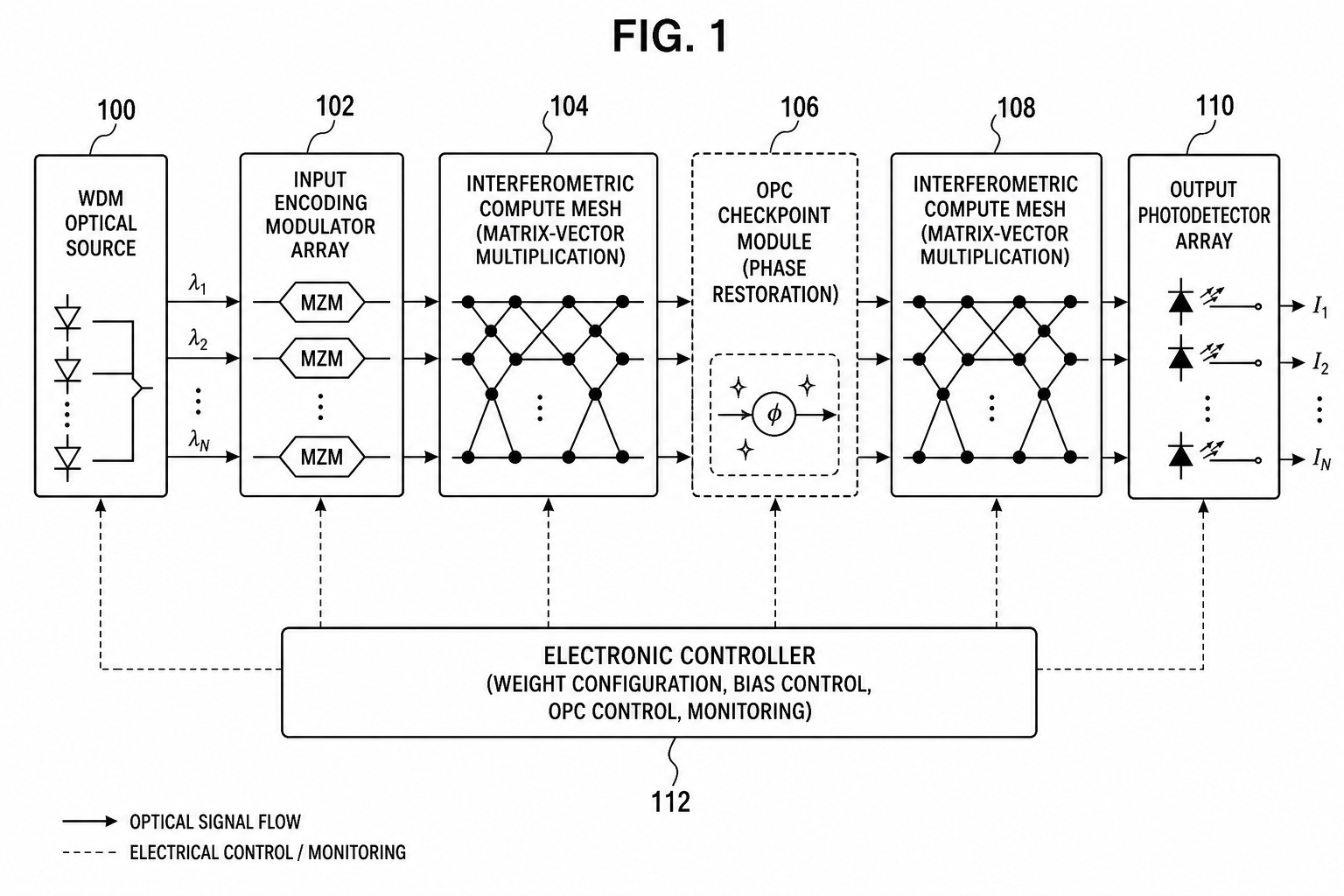
WDM Optical Source
Multi-channel wavelength-division multiplexed source providing up to 64 channels at 0.4 nm spacing across the C-band (1530–1565 nm). Supports partially coherent operation (0.4 nm linewidth) for expanded thermal tolerance — contradicting the orthodoxy of narrow-linewidth sources for interferometric compute.
Input Encoding Modulators
High-speed Mach-Zehnder or micro-ring modulators encoding electrical neural network activations (input data vectors) onto optical carriers. Supports amplitude and phase encoding for complex-valued tensor operations at rates up to 60 GHz.
Interferometric Compute Meshes
Reconfigurable MZI meshes (Clements/Reck/Diamond topology) performing matrix-vector multiplication via coherent optical interference. 64-mode mesh = ~2,016 MZI cells on 220 nm SOI. Each section implements one weight matrix; time-multiplexing enables multi-layer execution on a single mesh.
OPC Checkpoint Module
Nonlinear FWM restoration module between mesh sections. Phase-conjugates all N modes simultaneously via broadband FWM or parallel waveguides. Reverses accumulated phase errors, optionally provides parametric gain (50–100% conversion efficiency), and implements nonlinear activation function via power-dependent transfer characteristic.
Output Photodetectors
Photodetector array converting final processed optical tensor signals to the electrical domain. High-speed readout supports 1–60 GHz operational bandwidth. Balanced detection configuration enables coherent readout for phase-encoded weight matrices.
Electronic Controller
Control unit managing phase shifter weights, thermal biases, calibration loops, and mode switching. Interfaces with the RACT diagnostic subsystem for sub-nanosecond feedback. Manages OPC-aware trained weights deployed from the co-optimized training pipeline.
Performance parameters
| Parameter | Specification | Notes |
|---|---|---|
| Mesh scalability | 1,000+ MZI cells without accuracy collapse | Accuracy >90% at 2,000 cells (vs. <16% without OPC) |
| OPC error bounding | Phase error bounded to √S × σ per section | Prevents multiplicative compounding across total mesh depth |
| RACT calibration speed | <1 ns | All-optical conjugate telemetry loop; no O-E-O conversion delay |
| WDM parallelism | Up to 64 channels (C-band, 0.4 nm spacing) | Parallel tensor processing across wavelength channels |
| Inference latency | <10 ns per layer | Speed-of-light propagation; no memory bottleneck |
| Reconfiguration speed | <1 ns (EO) / <10 ps (all-optical) | TFLN switches enable layer-by-layer time multiplexing |
| Thermal operating margin | ±15 °C (vs. ±2.5 °C conventional) | Partially coherent regime + OPC; no active liquid cooling |
| Tensor throughput | 1–60 GHz operation | WDM + time-multiplexing for multi-layer inference |
| Activation function | Built-in (FWM power-dependent transfer) | Quadratic/sigmoid approximation; no E-O conversion needed |
| Operating modes | Dual-mode (classical AI inference / quantum computing) | Same MZI mesh, OPC modules, and waveguides for both |
Why this matters
Sub-10 ns Inference Latency
Matrix-vector multiplication at the speed of light through the MZI mesh. No electronic data conversion, no memory bottleneck — computation happens as photons traverse the chip in ~5 ps per mm.
Zero Drift Degradation
OPC checkpoints prevent the 84% accuracy collapse documented in scaled photonic networks. Phase errors are bounded per-section rather than compounding across the full mesh depth. Accuracy maintained indefinitely.
OPC-Aware Optimization
Novel training method models OPC modules as phase-error-canceling operators in the computational graph. Backpropagation through the OPC-augmented model co-optimizes weights with hardware error correction for deployment-matching accuracy.
Built-In Nonlinear Function
FWM conversion efficiency rises quadratically with signal power (∝ |γPL|²), providing a physical sigmoid-like activation function. Eliminates external electronic nonlinearities, saturable absorbers, or photodetector-to-modulator loops between layers.
6× Expanded Thermal Margin
Partially coherent optical regime (0.4 nm linewidth) combined with checkpointed OPC expands operating margin from ±2.5 °C to ±15 °C — eliminating active liquid cooling and reducing packaging costs.
Same Hardware as Quantum
The accelerator shares MZI mesh, OPC modules, waveguides, and switches with the quantum processor (Patent 01/Patent 06). One manufacturing line, one chip design — two $100B+ markets served simultaneously.
Built on established science
Demonstrated by MIT & Stanford
Programmable MZI meshes for optical matrix multiplication demonstrated by Shen et al. (MIT, Nature Photonics 2017) and scaled to >16,000 components at 1 GHz (Nature, 2025). Architecture is proven — QLT adds the missing stability layer.
Clements/Reck Decomposition
Mathematical decomposition of unitary matrices into MZI networks is established linear algebra (Reck 1994, Clements 2016). Every neural network weight matrix can be physically encoded as phase shifter settings in the mesh.
Telecom-Proven Technology
Mid-span OPC for signal restoration has been deployed in fiber telecommunications since the 1990s (AT&T, NTT, Alcatel-Lucent). FWM in chalcogenide waveguides achieves >16 dB parametric gain over 180 nm bandwidth (Lamont et al., 2008).
Problem Quantified in Literature
The 84% accuracy degradation is documented by Banerjee et al. (IEEE JLT, 2024; arXiv 2204.03835) across Reck, Clements, and Diamond topologies. The field's response was software mitigation — QLT provides the hardware solution.
Related patents in the QLT portfolio
Room-Temperature Photonic Quantum Processor
The complete quantum processor architecture sharing the same MZI mesh, OPC modules, and waveguide platform. Patent 07 is the classical AI inference mode of this dual-use hardware.
View Patent → Patent 02 · Nonlinear WaveguideHybrid Nonlinear Waveguide for OPC
The engineered χ⁽³⁾ waveguide structures (SOH, TFLN, AlGaAs) used in Patent 07's OPC checkpoint modules for four-wave mixing phase conjugation and parametric gain.
View Patent → Patent 12 · CalibrationReal-Time Adaptive Calibration (RACT)
The Recursive All-Optical Conjugate Telemetry circuit providing sub-nanosecond diagnostic feedback for Patent 07's mesh phase shifters — enabling real-time weight correction during inference.
View Patent → Patent 08 · OPC Lattice MethodPeriodic Optical Phase Conjugation Method
The foundational OPC lattice methodology adapted for Patent 07's AI inference context — periodic phase restoration that bounds error to √S × σ per section regardless of total mesh depth.
View Patent →Quantum hardware that pays for itself with AI
Patent 07 gives QLT a near-term revenue path in the $100B+ AI inference accelerator market. While quantum computing matures, the same chip hardware — same MZI mesh, same OPC modules, same fab line — generates revenue as the world's most accurate photonic AI accelerator. Top targets: hyperscalers (Microsoft, Google, Meta), AI infrastructure (CoreWeave, Lambda), and edge inference (automotive, telecom).