Periodic Phase Conjugation Lattice Method
The mathematical architecture that transforms unbounded error growth into bounded steady-state — enabling quantum circuits of arbitrary depth without catastrophic decoherence.
Phase errors grow linearly with circuit depth
In every photonic quantum processor, manufacturing imperfections and thermal fluctuations introduce small phase errors at each gate. These errors accumulate linearly — after 50-100 gates, the cumulative error exceeds the quantum error correction threshold. This "coherence wall" is the fundamental barrier to useful photonic quantum computation.
Periodic phase reversal bounds error to a constant
By distributing phase-conjugation stages at regular intervals throughout the circuit, QLT transforms error scaling from unbounded linear growth to a bounded constant. Total error is determined by the interval between correction stages — not total circuit depth. A 10,000-gate circuit accumulates no more error than a 100-gate circuit.
Why this matters
Constant-Time Error Instead of Linear
Error accumulation is mathematically bounded to a steady-state value regardless of circuit depth. This changes the fundamental scaling equation for photonic quantum computing.
No Measurement Required
Phase conjugation reverses errors without measuring the quantum state. No ancilla qubits consumed, no measurement-induced collapse, no classical processing delay.
All Encoding Formats
Works with dual-rail, time-bin, frequency-bin, and continuous-variable qubit encodings. One error-correction architecture spans the entire photonic quantum computing landscape.
Even Low Efficiency Works
Even at low per-stage conversion efficiency, the compounding effect across multiple stages produces bounded error. No single stage needs perfect performance.
300K Operation
OPC stages operate at room temperature via four-wave mixing in nonlinear waveguides. No cryogenics needed for the error-correction architecture.
Linear Area Overhead
Each OPC stage adds one waveguide section to the circuit. Area overhead scales linearly — not exponentially like qubit-based error correction schemes.
OPC Lattice in Quantum Circuit
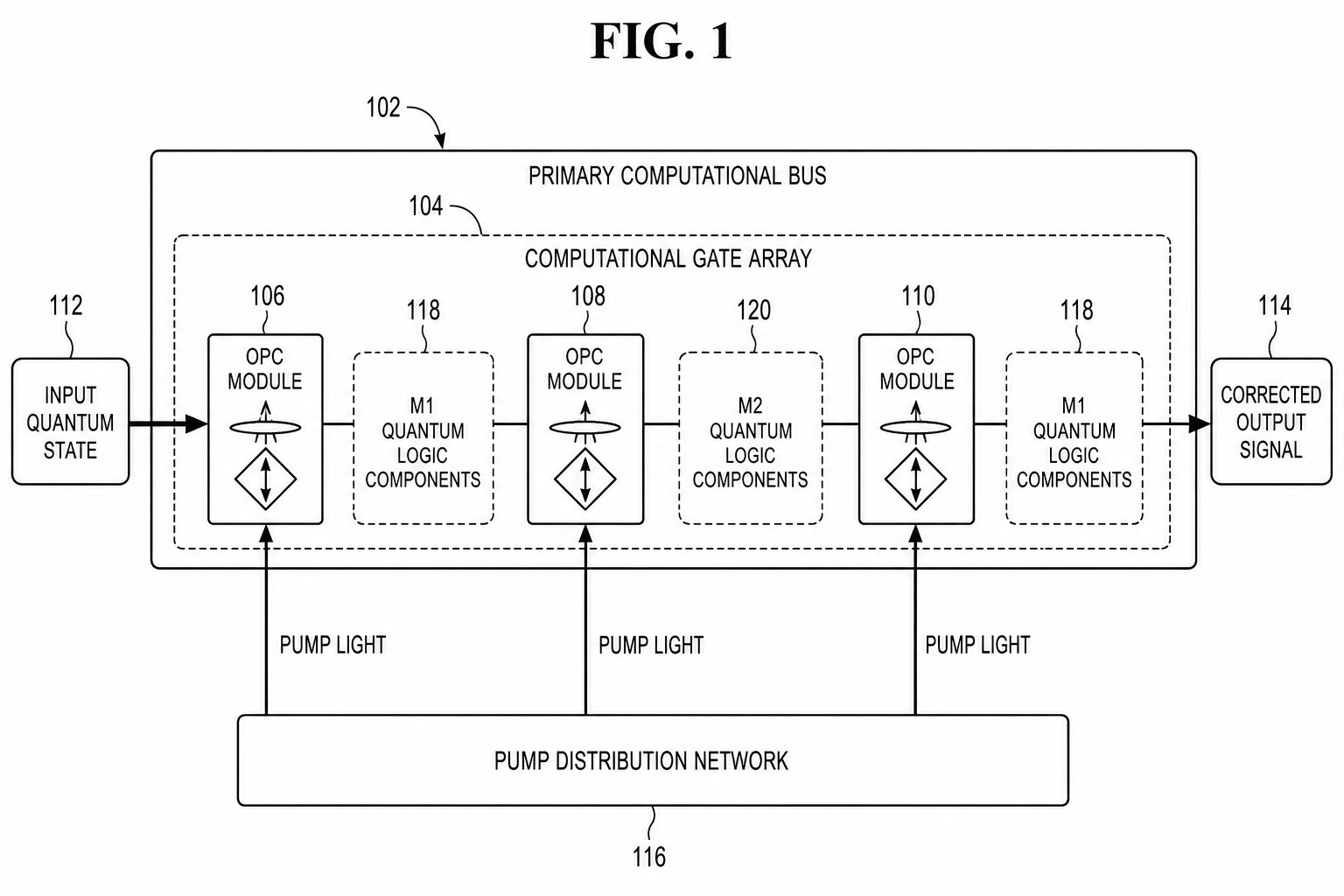
Primary Quantum Signal Path
The main waveguide bus carrying photonic qubits through sequential gate operations. Provides low-loss routing between gate array stages and OPC correction modules.
Quantum Logic Operations
Beam splitters, phase shifters, and Mach-Zehnder interferometers implementing quantum logic gates. Each gate contributes phase error variance σ² to the traversing qubit.
Phase Conjugation Stages
Nonlinear waveguide sections performing four-wave-mixing-based phase conjugation. Distributed at variable intervals M1, M2 throughout the circuit to bound cumulative error.
Coherent Pump Delivery
Optical pump laser routed via on-chip splitter tree to each OPC module. Maintains phase coherence and power balance across all conjugation stages simultaneously.
System parameters & performance bounds
| Parameter | Value / Range | Notes |
|---|---|---|
| Phase Error Bound | V∞ ≤ σ²_seg / η | Steady-state variance independent of total circuit depth |
| OPC Interval (M) | 5–20 gates | Variable spacing; optimized per circuit topology |
| Placement Strategy | Periodic & Adaptive | Fixed-interval or noise-sensor-triggered insertion |
| Supported Encodings | 4 types | Dual-rail, time-bin, frequency-bin, continuous-variable |
| Recirculation Option | Time-multiplexed | Single OPC module reused via delay-loop recirculation |
| Conversion Efficiency (η) | 0.01–0.50 | Even 1% per stage yields bounded error across lattice |
| Operating Temperature | 300 K (room temp) | No cryogenic infrastructure required |
| Nonlinear Mechanism | FWM / BS-FWM / SHG | Four-wave mixing, Bragg-scattering FWM, or SHG-based |
| Noise Floor | < 1 photon/mode | Spontaneous emission maintained below single-photon level |
| Circuit Scalability | Arbitrary depth | 10,000+ gates with same error as 100-gate segment |
Built on established science
40 Years in Telecom
Periodic phase conjugation for dispersion management in fiber optics has been used in telecommunications since the 1980s. QLT applies the identical physics principle to quantum circuits.
Textbook Nonlinear Optics
FWM-based phase conjugation is a standard chapter in every nonlinear optics textbook (Boyd, Agrawal). The physics is among the most well-characterized nonlinear optical processes.
Related patent filings
Room-Temperature Quantum Processor
The flagship processor architecture into which the OPC lattice is integrated. Patent 08 defines how phase correction is deployed across the Patent 01 computation circuit.
View Patent →Self-Phase-Matched Nonlinear Waveguide
The physical waveguide platform that implements each OPC module. Patent 02 provides the nonlinear medium in which four-wave mixing performs phase conjugation.
View Patent →Hybrid Waveguide with Acoustic Suppression
Advanced waveguide variant with APBG structures that suppress Brillouin scattering — enabling higher pump powers and improved OPC efficiency within the lattice.
View Patent →Multiplexed Source Correction
Extends OPC correction to the photon source stage. Together with Patent 08, forms a two-layer error correction pipeline from source through computation.
View Patent →The error-correction method that makes the processor work
Patent 08 defines how the coherence-restoration engine (Patent 02) is deployed across the processor (Patent 01). It is the method patent that blocks anyone from using periodic phase conjugation for quantum error correction — regardless of what waveguide or materials they use.