Phase-Corrected Multiplexed Single-Photon Source
Multiplexed photon sources boost delivery rates — but each path introduces different phase errors. This patent ensures every photon arrives identically, regardless of which source or route delivered it.
Multiplexed photon sources degrade quantum quality
Single-photon sources are probabilistic — any given source has ~10-30% success probability per pulse. Multiplexing N sources boosts delivery rates, but each source-to-output path has different length, dispersion, and thermal environment. The delivered photons become distinguishable, destroying the Hong-Ou-Mandel interference critical for quantum logic gates.
Phase-conjugation in the switching network
An OPC module positioned within the photon-routing switch network reverses all path-dependent phase errors, differential dispersion, and thermal noise — regardless of which source was selected or which route was taken. Every delivered photon arrives with identical quantum properties, restoring HOM visibility to fault-tolerant levels.
Why this matters
Restored HOM Visibility
Hong-Ou-Mandel interference visibility restored to >99% — the threshold required for fault-tolerant quantum computing. Path-dependent errors are eliminated, not just reduced.
All Multiplexing Types
Covers spatial, temporal, frequency, and hybrid multiplexing architectures. Whatever multiplexing strategy a competitor might use, this patent's correction method applies.
Auxiliary Calibration Field
A classical reference field extracts real-time correction parameters without disturbing the quantum signal — enabling continuous self-optimization during computation.
< 0.1 Photons Per Mode
Noise from the OPC process maintained below 0.1 photons per mode — ensuring the correction process doesn't introduce more errors than it fixes.
Three-Layer OPC Pipeline for Multiplexed Source
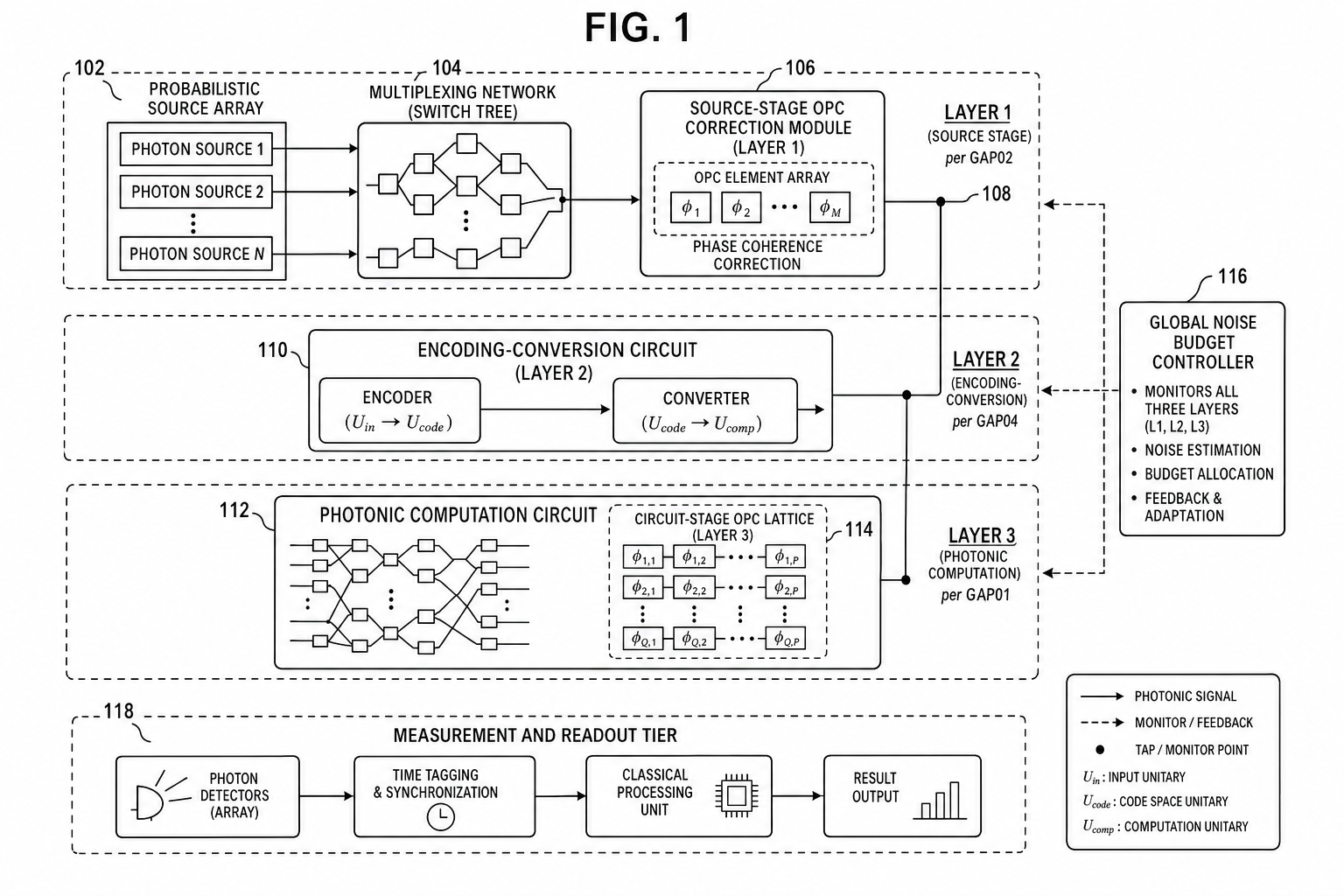
Heralded Photon Generation
K parallel single-photon sources using SFWM in micro-ring resonators or SPDC in lithium niobate waveguides. Each source fires probabilistically at p = 0.01–0.15 per pulse.
Active Photon Routing
Binary switch tree in log₂(K) stages routing the successfully heralded photon to the output. Source of path-dependent phase bias, dynamic noise, and differential GVD.
Multiplexer Output Correction
Phase conjugation at the switch tree output normalizes route-dependent phase and temporal distortions. Restores photon indistinguishability regardless of source or path taken.
Per Patent 11 — Format Translation
OPC-corrected encoding conversion between qubit formats (e.g., time-bin to dual-rail). Ensures format translation preserves the phase-equalized state from Layer 1.
Per Patent 08 — Computation Correction
Periodic OPC stages distributed throughout the quantum logic circuit bound phase errors during computation. Completes the three-layer end-to-end correction pipeline.
Cross-Layer Noise Management
Regulates pump powers and spectral detuning across all three OPC layers to maintain total spontaneous noise below 0.1 photons per mode system-wide.
System parameters & performance targets
| Parameter | Value / Range | Notes |
|---|---|---|
| Noise Floor | < 0.1 photons/mode | Global budget across all three OPC layers |
| Multiplexing Modalities | Spatial / Temporal / Frequency / Hybrid | All four architectures covered by single patent |
| HOM Visibility (corrected) | > 99% | Fault-tolerant threshold for quantum gates |
| Auxiliary Calibration | Classical co-propagating field | Real-time parameter extraction up to 10 MHz sampling |
| Switch-Tree Correction | Progressive (per-stage) | OPC modules between successive switch stages |
| Source Success Probability | P = 1-(1-p)^(K·T) | K spatial × T temporal slots; >96% at K=8, T=4 |
| Pump Power Range | 10–150 mW (CW) | Hybrid Si₃N₄/chalcogenide platform |
| Path-Dependent Phase Bias | Fully conjugated | Static + dynamic phase errors reversed by OPC |
| Differential GVD Correction | Complete reversal | Temporal mode shape restored for all routes |
| Operating Temperature | 300 K (room temp) | No cryogenic infrastructure required |
Built on established science
Demonstrated by PsiQuantum & Xanadu
Spatial and temporal multiplexing of single-photon sources has been demonstrated by multiple groups. PsiQuantum's architecture depends on multiplexing. QLT adds the missing phase correction.
Nobel-Prize-Adjacent Physics
HOM interference (1987) is the gold-standard test for photon indistinguishability. The metric and measurement technique are universally accepted in quantum photonics.
Related patent filings
Ultrafast Optical Switching
The technology-agnostic ultrafast optical switch (committed TFLN electro-optic baseline, sub-ns; fs piezo upgrade verification-pending) that enables the fast photon-routing switch tree. Patent 03 provides the physical switching mechanism that Patent 09 corrects.
View Patent →Periodic OPC Lattice Method
Layer 3 of the three-layer pipeline. Patent 08's circuit-stage OPC lattice provides computation-phase correction downstream of Patent 09's source-stage correction.
View Patent →OPC-Assisted Encoding Conversion
Layer 2 of the pipeline. Encoding-format translation with integrated OPC correction bridges the source output to the computation circuit's qubit format.
View Patent →Room-Temperature Quantum Processor
The flagship processor that receives phase-corrected photons from Patent 09's multiplexed source subsystem. Patent 09 ensures Patent 01 receives indistinguishable qubits.
View Patent →Closing the multiplexing gap
Every photonic quantum computer needs multiplexed sources. Patent 09 ensures that anyone building a multiplexed source will need QLT's phase-correction method to achieve fault-tolerant photon quality.