Ultrafast Optical Switching for Quantum Feed-Forward
The quantum control layer — a switching subsystem that routes photonic qubits in femtoseconds across three critical functions: feed-forward routing, source multiplexing, and dynamic circuit reconfiguration.
Electronic switches are too slow for quantum photonics
Measurement-based quantum computing requires instant routing decisions: detect a photon, then redirect the next photon before it exits the circuit. Electronic CMOS switches are fundamentally capped by RC time constants at nanosecond timescales — but photons traverse chip-scale circuits in picoseconds. With photon pulse durations of 10–100 ps, the switch must fully transition in <1 ps to avoid time-dependent amplitude modulation that collapses the qubit's superposition. Thermo-optic phase shifters (μs-scale) are orders of magnitude too slow for time-multiplexed reconfiguration at GHz rates.
Technology-agnostic quantum-grade switching subsystem
QLT's switching subsystem specifies quantum-grade performance requirements (<0.05 rad phase perturbation, <0.5 dB insertion loss, >20 dB extinction, <0.001 noise photons/event) and claims all switch technologies meeting them — piezoelectric nano-actuators, electro-optic MZIs (LNOI/BTO), Kerr-effect cross-phase-modulation, and MEMS. Critically, switches integrate directly with OPC modules that reverse any phase perturbation introduced by the switching actuation and associated delay waveguides.
System overview
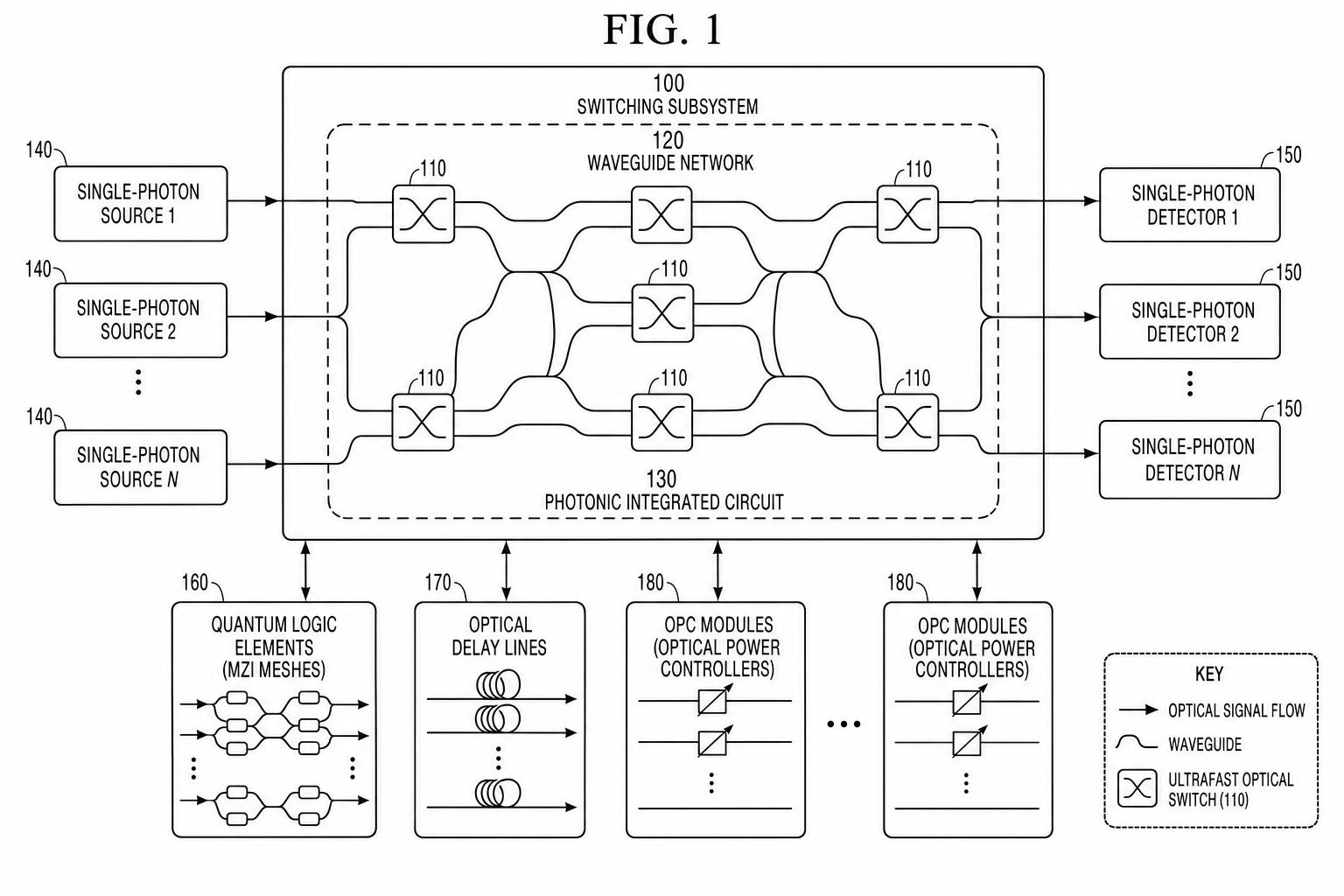
FIG. 1 — System-level block diagram of the switching subsystem (110) integrated within the photonic quantum processor, showing the spatial arrangement of ultrafast switches, optical delay lines (170), OPC modules (180), single-photon sources (140), detectors (150), and quantum logic elements (160).
Ultrafast Optical Switches (110) + Waveguide Network
A plurality of ultrafast optical switches distributed throughout a quantum-grade waveguide network interconnecting single-photon sources, detectors, MZI logic meshes, and optical delay lines. Different switch types can be deployed at different locations: sub-ps Kerr switches for reconfiguration, piezoelectric actuators for feed-forward, MEMS for high-extinction routing nodes.
Three Quantum Functions + OPC Integration
Each switch performs one of three quantum-specific functions: (1) feed-forward routing conditioned on measurement outcomes via optical delay synchronization; (2) source multiplexing through log₂(K)-stage binary trees for near-deterministic photon delivery; (3) circuit reconfiguration between photon pulses at rates exceeding the repetition rate. OPC modules positioned after each switch reverse accumulated phase errors from delay waveguides and switching actuation.
Why this matters
Sub-ns Committed, fs Upgrade Path
The committed v1 baseline is a thin-film lithium niobate (TFLN) electro-optic switch operating sub-nanosecond — fast enough to complete a feed-forward decision before a photon exits its delay line. Reported piezoelectric nano-actuator transition times of ~150–175 fs (independent verification pending) define an upgrade path, not the baseline claim. Kerr-effect switches demonstrated at 1 ps with 500 GHz repetition rate (Purakayastha et al., Frontiers in Optics, 2022). Circuit reconfiguration completes between successive photon pulses at GHz rates.
Preserves Quantum States
Phase perturbation <0.05 rad rms per event (piezoelectric: <0.01 rad via symmetric push-pull; electro-optic: <0.005 rad via balanced MZI; Kerr: <0.02 rad with 40+ nm pump-signal separation). Insertion loss <0.5 dB. Extinction ratio >20 dB. Entanglement fidelity ≥99% — quantum state preservation verified by concurrence and Bell inequality.
Three Critical Roles
Feed-forward routing: measure → process (FPGA ~10 ns) → switch before qubit exits delay line. Source multiplexing: log₂(K)-stage binary tree with balanced path lengths for <0.5 dB per stage. Circuit reconfiguration: toggle MZI mesh between pre-set phase values at rates exceeding photon repetition rate.
OPC-Compatible Architecture
Switches adjacent to each OPC module selectively engage or bypass correction stages based on real-time diagnostic feedback. In time-multiplexed operation, photons route through recirculation loops containing both reconfigurable mesh elements and OPC modules — a new gate operation and phase correction on each pass.
<0.001 Photons Per Event
Noise floor three orders of magnitude below a single photon per switching event. Kerr-type switches require >40 dB pump rejection filters. Piezoelectric actuators generate zero noise photons inherently. Background counts do not interfere with single-photon quantum signals at any switch location.
4 Switch Technologies Claimed
Patent covers all mechanisms meeting quantum-grade requirements: (1) electro-optic LNOI/BTO MZIs (committed v1 baseline — mature fab, >100 GHz BW); (2) piezoelectric nano-actuators (verification-pending fs upgrade, zero noise); (3) Kerr-effect XPM (sub-ps, no moving parts); (4) MEMS (highest extinction >40 dB, zero static power). Future technologies captured.
Key performance parameters
| Parameter | Specification | Significance |
|---|---|---|
| Switching Speed | Sub-ns (TFLN electro-optic, committed); <1 ps (Kerr); ~150–175 fs (piezoelectric, verification-pending) | Committed baseline completes full transition before photon pulse arrives; fs piezo is an upgrade path |
| Insertion Loss | <0.5 dB per switch (pass-through state) | Each dB = ~20% photon loss probability; critical for multi-stage trees |
| Extinction Ratio | >20 dB (general); >40 dB (MEMS) | Prevents crosstalk photons from unselected sources entering circuit |
| Phase Perturbation | <0.05 rad rms per event | Maintains HOM visibility >99% between photons from different paths |
| Noise Photon Generation | <0.001 photons/event/temporal mode | 3 orders of magnitude below single-photon signal level |
| Feed-Forward Latency Budget | <1 ns (switch activation) | Completes before target qubit exits optical delay waveguide |
| Source Multiplexing Stages | log₂(K) for K parallel sources | Binary tree topology with balanced path lengths per stage |
| Entanglement Fidelity | ≥99% (concurrence/Bell violation) | Quantum state preservation through switch actuation verified |
| Supported Switch Types | 4 (piezoelectric, EO, Kerr, MEMS) | Technology-agnostic claims capture future switch innovations |
| Delay Line Loss (Si₃N₄) | <0.1 dB/m (~0.2 dB for 2m feed-forward) | Ultra-low-loss waveguide spiral holds qubit during processing |
Built on established science
Commercial Electro-Optic Platform
LNOI switches demonstrated by HyperLight, Lumenaric, and multiple academic groups. BTO-on-silicon achieves Vπ·L ~0.54 V·cm with 152 GHz bandwidth. A 2025 TFLN temporal multiplexer demonstrated photon routing at 62.2 MHz — confirming quantum-grade EO switching at telecom wavelengths.
Sub-Picosecond Demonstrated
Purakayastha et al. (Frontiers in Optics, 2022) demonstrated 1 ps switching at 500 GHz repetition rate with 140:1 SNR. All-optical Kerr switching for heralded single photons demonstrated at 2.3 ps (arXiv 2504.12376, 2025) — confirming quantum-level operation is achievable.
High-Extinction Photonic Switches
Piezoelectric MEMS on silicon nitride achieved modulation rates >100 MHz with extinction ratios exceeding 20 dB (Nature Communications, 2025). Zero static power consumption and no noise photon generation make MEMS ideal for high-extinction routing nodes.
KLM / Measurement-Based QC
Feed-forward quantum computing established by Knill, Laflamme, Milburn (KLM protocol) and Raussendorf, Browne, Briegel (cluster states). PsiQuantum/Xanadu have demonstrated feed-forward architectures requiring exactly the switch performance specifications claimed here.
Connected patent architecture
Processor Architecture
The HR-PSQA system that integrates these switches within its waveguide network for all three quantum functions — the parent system architecture that this switching subsystem enables.
View Patent →Multiplexed Single-Photon Source
Phase-coherence-corrected multiplexed source using the binary-tree switch topology disclosed here with OPC correction at the tree output for heralded photon delivery.
View Patent →Periodic OPC Lattice
The distributed OPC method that places correction modules after switch locations — reversing phase perturbations from both switching actuation and optical delay waveguide propagation.
View Patent →The quantum control layer
Alongside Patent 01 (processor architecture) and Patent 02 (OPC waveguide), this patent completes the core hardware triad. The switch is the active component that turns a passive optical circuit into a programmable quantum computer — providing the feed-forward control, deterministic photon delivery, and dynamic reconfiguration that fault-tolerant photonic QC demands.