OPC-Assisted Qubit Encoding Conversion
Quantum networks will use different qubit encoding formats at different nodes. This patent ensures seamless, high-fidelity translation between any two formats — the "USB-C of quantum networking."
Quantum systems speak different languages
Different quantum platforms encode qubits differently: trapped ions use time-bin, fiber networks use polarization, photonic processors use dual-rail. Today, converting between formats introduces phase errors, dispersion, and birefringence that destroy quantum fidelity. There is no universal quantum adapter.
Phase-conjugation-corrected encoding conversion
An OPC module positioned at the conversion boundary reverses all encoding-conversion-induced errors — thermal drift, dispersion, birefringence — preserving qubit fidelity through the translation. Bidirectional conversion between any two formats. Cascaded multi-stage conversions maintain bounded cumulative error.
Technical Architecture
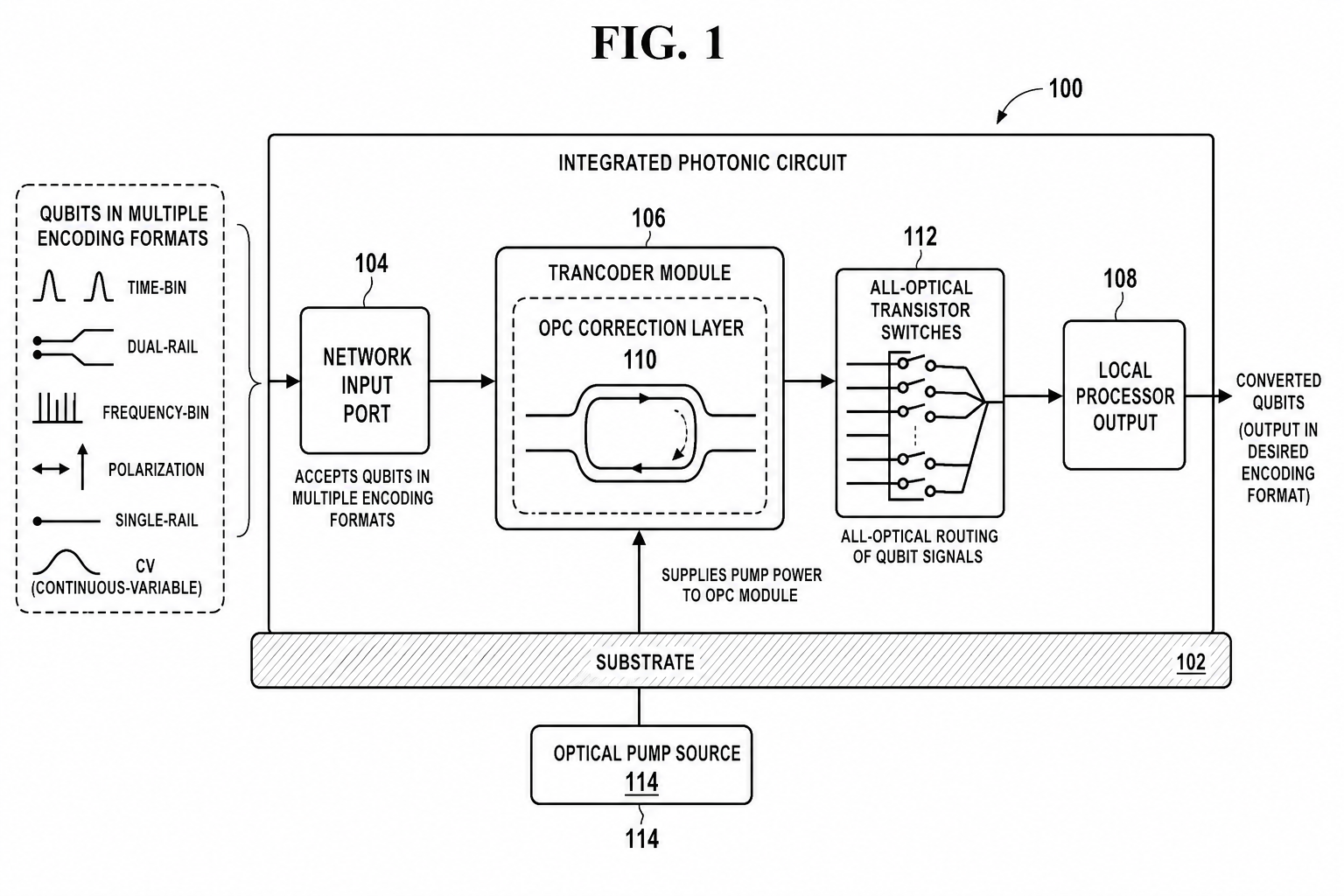
Universal Encoding Receiver
Accepts qubits in any of 6 supported encoding formats: time-bin, dual-rail, frequency-bin, polarization, single-rail, and continuous-variable. Coupled to the transcoder module for format conversion to the processor's native encoding.
Deterministic Format Conversion
Converts input qubits from any supported encoding to the target format using unbalanced MZIs, wavelength-selective routing, and polarization beam splitters. Incorporates the OPC correction layer (110) for phase-error reversal during conversion.
Nonlinear Phase-Conjugation Engine
Reverses phase-sensitive errors introduced during basis conversion via four-wave mixing. Driven by optical pump source (114). Supports 4 placement strategies: output-stage, midpoint, input-stage, and bidirectional configurations.
Sub-ns Quantum State Routing
Facilitates signal routing with a committed sub-nanosecond TFLN electro-optic switch (a reported ~150–175 fs piezo actuator is a verification-pending upgrade path) and total switching attenuation below 1.5 dB. Preserves multi-pair operational success in heralded quantum states for deterministic encoding conversion.
Why this matters
All Major Encoding Formats
Bidirectional conversion between dual-rail, time-bin, frequency-bin, polarization, single-rail, and continuous-variable encodings. Every quantum platform is covered.
Flexible OPC Architecture
Four OPC placement strategies — output, midpoint, input, and bidirectional — optimized for different conversion topologies and use cases.
Multi-Stage Bounded Error
Multi-hop encoding conversions maintain bounded cumulative error — critical for heterogeneous quantum networks where data traverses multiple encoding format boundaries.
Network Interface Module
A defined optical/electrical interface specification enables standardized quantum network adapters — plug any quantum processor into any quantum network.
Technical Specifications
| Parameter | Specification | Value |
|---|---|---|
| Supported Encodings | Bidirectional conversion between all major photonic qubit formats | 6 formats |
| Encoding Formats | Time-bin, dual-rail, frequency-bin, polarization, single-rail, continuous-variable | All pairs |
| Switching Speed | Committed TFLN electro-optic baseline (fs piezo upgrade verification-pending) | Sub-ns |
| Insertion Loss | Total switching attenuation through all-optical transistor switch | <1.5 dB |
| OPC Strategies | Output-stage, midpoint, input-stage (pre-correction), and bidirectional | 4 placements |
| Conversion Mode | Deterministic encoding conversion without probabilistic post-selection | Deterministic |
| Pipeline Layer | Integrates as Layer 2 in three-layer OPC coherence management pipeline | Layer 2 |
| Fidelity (CW OPC) | Improvement with continuous-wave OPC at 1–2% conversion efficiency | +0.5–1 pp |
| Fidelity (Pulsed OPC) | Pulsed OPC at >20% efficiency or combined OPC + low-rate active tracking | >99% |
| Operating Temperature | Ambient-temperature operation on Si₃N₄ or TFLN substrate | 300 K |
Built on established science
Demonstrated in Labs
Time-bin to dual-rail and polarization to path-encoding conversions have been demonstrated by multiple research groups. The conversion circuits are known — QLT adds fidelity preservation.
Standards Under Development
The ITU, IEEE, and IETF are actively developing quantum network standards. Encoding conversion will be a mandatory interface function — this patent covers the solution.
Cross-References
Patent 09 — Multiplexed Single-Photon Source
Source-stage OPC corrects phase errors from the multiplexed photon switching network, delivering phase-equalized photons to the encoding converter. Layer 1 of the three-layer coherence pipeline.
Patent 08 — Periodic Phase Conjugation Lattice
Circuit-level OPC lattice periodically corrects phase errors accumulated during quantum computation. Layer 3 of the pipeline — shares a common OPC module at the interface with Layer 2.
Patent 01 — Room-Temperature Quantum Processor
The flagship processor architecture that this encoding converter interfaces with. Patent 11 enables the processor to receive qubits from any quantum platform in any encoding format.
Patent 13 — Quantum Entanglement Distribution
Fiber-network entanglement distribution using passive OPC. Combined with Patent 11, QLT controls both sides of the processor-to-network interface — encoding conversion and fiber transmission.
The quantum network adapter patent
Patent 11 is essential for QLT's networking play. Combined with Patent 13 (fiber distribution), it positions QLT to control the interface layer between quantum processors and quantum networks — a chokepoint in every quantum internet architecture.