Passive Quantum Entanglement Distribution Over Fiber
Distributing entangled photons over existing fiber networks without active error compensation — replacing millions of dollars of servo loops, feedback controllers, and cryogenic repeaters with a single passive optical module.
Fiber networks destroy quantum entanglement
When entangled photons travel through optical fiber, three physical mechanisms degrade them: phase noise from temperature fluctuations (~1,000 radians over 50 km), chromatic dispersion that broadens photon wavepackets by 850 ps, and polarization mode dispersion that scrambles quantum states. Current solutions require active electronic compensation with kHz servo loops, cryogenic repeaters, and dedicated dispersion-compensating modules.
Passive mid-span phase conjugation
An OPC module spliced into the fiber at the midpoint generates a phase-conjugate of each entangled photon. The conjugated photon traverses the second half of the fiber, and the accumulated errors cancel. No servo loops, no feedback, no measurement — pure passive physics. Entanglement fidelity rises from <50% to 70-85% with OPC alone, or >95% with minimal low-rate active tracking.
Technical Architecture
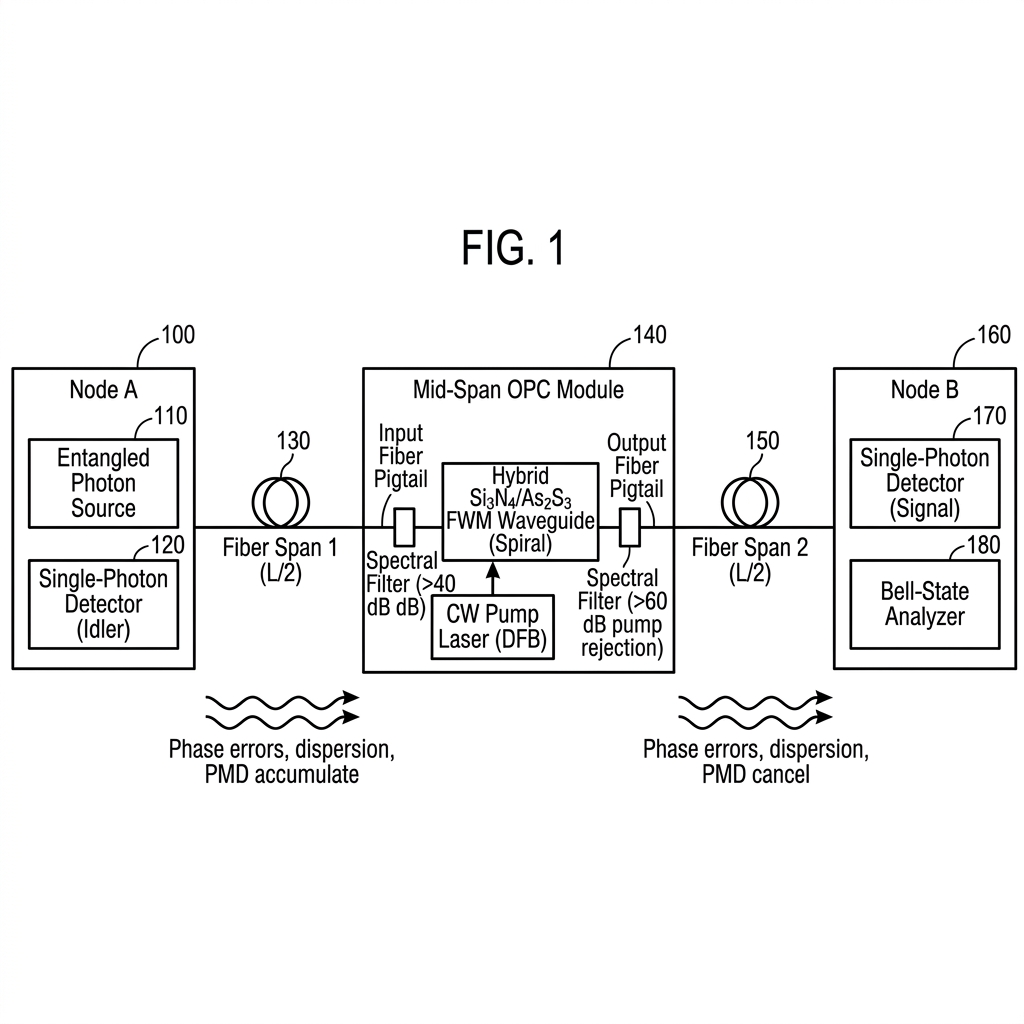
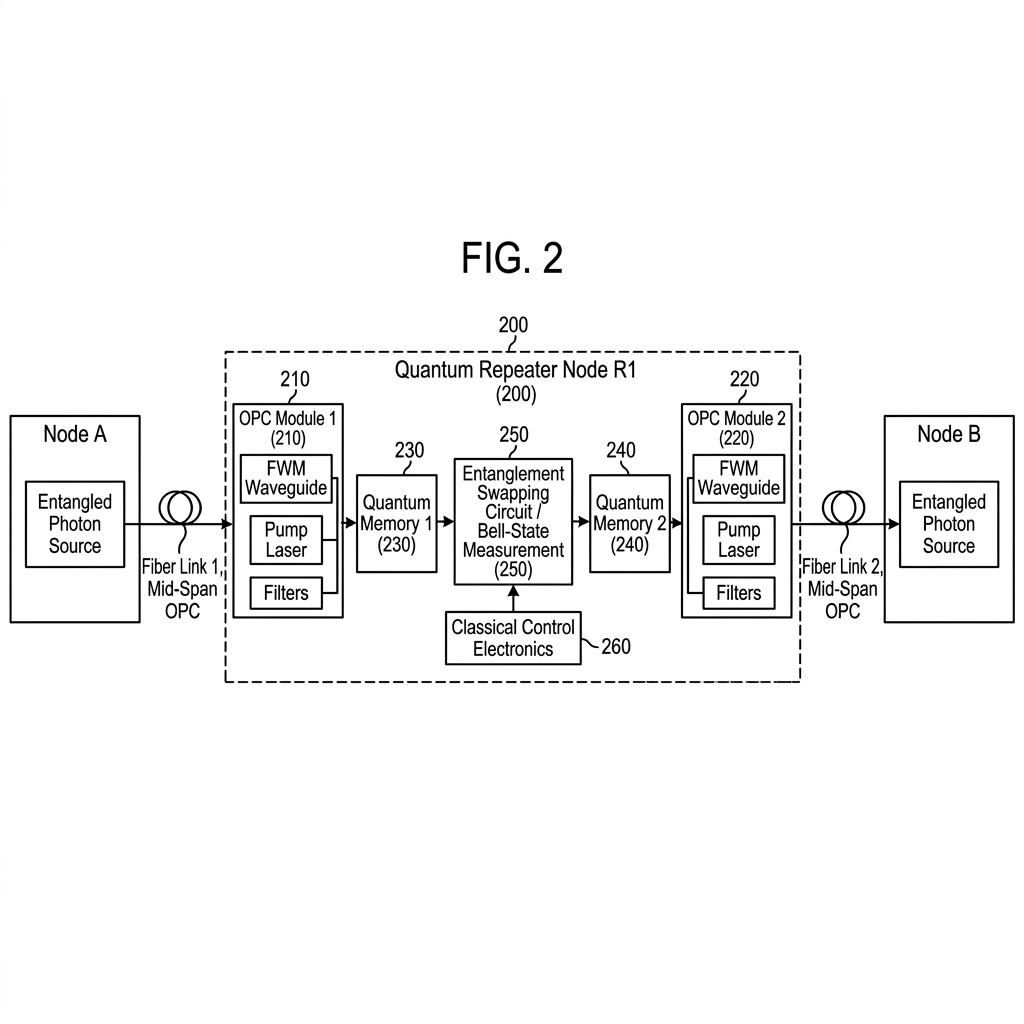
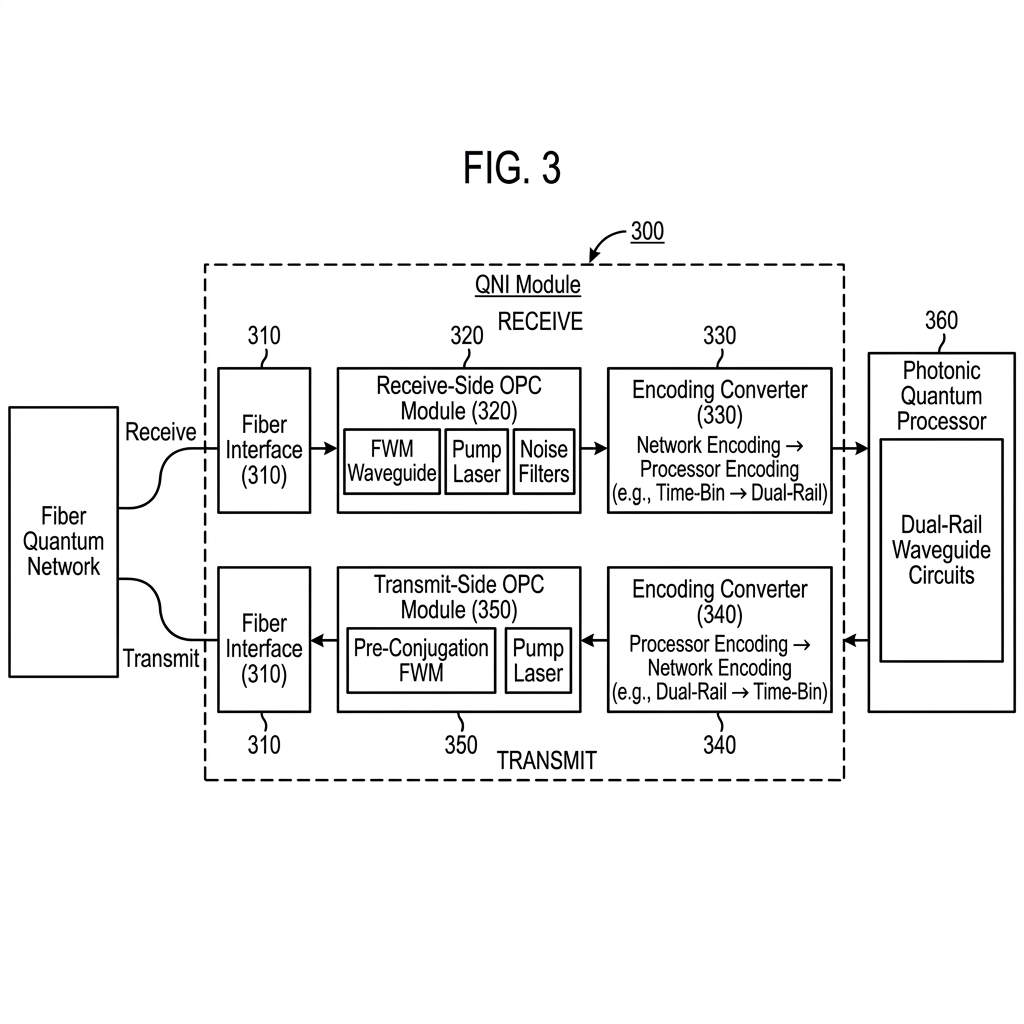
CFM-HPC Stabilizer Hub
Centralized frequency-multiplexed hybrid phase-conjugate stabilizer module containing a CW pump laser, hybrid Si₃N₄/As₂S₃ nonlinear waveguide, and AWG router. Frequency-multiplexes phase correction across up to 64 network branches from a single installation point.
Frequency-Multiplexed Distribution
Arrayed waveguide grating router multiplexes quantum channels onto the primary fiber trunk. An optical splitter distributes phase-corrected signals to passive remote nodes — zero active stabilization required at terminals.
Point-to-Point, Repeater, QNI
Mid-span OPC for direct links up to ~100 km. OPC-equipped quantum repeater nodes for long-haul cascaded links. QNI modules at processor-to-network boundaries with pre-conjugative pre-distortion for proactive error compensation.
Room-Temperature Operation at 300K
All remote nodes operate passively at ambient temperature with zero active stabilization power. Eliminates cryogenic repeaters (450–3,200 W per node), reducing per-node power draw to ~15 W steady-state for deployment in standard telecom cabinets.
Why this matters
No Active Feedback
Once the pump laser activates, the OPC module continuously corrects errors without electronic feedback, servo loops, or monitoring electronics. Zero ongoing complexity.
Dispersion + Phase + PMD
OPC simultaneously corrects chromatic dispersion, phase noise, and first-order polarization mode dispersion — three error types that current systems address with three separate subsystems.
Point-to-Point, Repeater, QNI
Mid-span OPC for direct links. OPC-equipped quantum repeater nodes for long distance. OPC quantum network interface modules for processor-to-network connection. Complete coverage.
No Cryogenic Repeaters
The entire system — OPC modules, repeater nodes, and network interfaces — operates at room temperature. No dilution refrigerators, no ion traps, no cryogenic infrastructure.
Live Fiber Deployment
Install on existing fiber carrying classical telecom traffic without service interruption. No new fiber needed, no equipment changes at the endpoints — just splice in the OPC module.
All Qubit Encodings
Works with time-bin, polarization, and frequency-bin encoded entanglement — the three major encoding formats used in quantum networking research and commercial QKD systems.
Technical Specifications
| Parameter | Specification | Value |
|---|---|---|
| Phase Error Correction | Cumulative phase noise over 50 km fiber from thermal fluctuations | >1,000 rad |
| Dispersion Compensation | Temporal broadening of photon wavepacket over 50 km at 1550 nm | 850 ps |
| Fidelity (Uncorrected) | Entanglement fidelity over 50+ km without OPC correction | <50% |
| Fidelity (OPC Only) | Entanglement fidelity with passive mid-span OPC alone | 70–85% |
| Fidelity (OPC + Tracking) | OPC combined with minimal low-rate active phase tracking | >95% |
| Operating Temperature | All modules — OPC, repeaters, QNI — at ambient temperature | 300 K |
| Network Configurations | Mid-span OPC, OPC quantum repeater, QNI processor-to-network | 3 modes |
| Raman Noise Floor | Parasitic noise from hybrid Si₃N₄/As₂S₃ waveguide engineering | <0.1 photons/mode |
| Node Power Draw | Steady-state per-node power replacing cryogenic 450–3,200 W systems | ~15 W |
| Fiber Compatibility | G.652 standard single-mode fiber with classical telecom coexistence | Existing fiber |
Built on established science
Deployed in Classical Telecom
Mid-span OPC for dispersion compensation has been used in fiber-optic telecommunications since the 1990s. AT&T, NTT, and Alcatel-Lucent have demonstrated it at scale. QLT extends it to single-photon quantum signals.
Commercial Market Exists
QKD is already a commercial market (Toshiba, ID Quantique, Qunnect). QLT's passive OPC improves key rates and extends reach for these existing products — a proven customer base.
Demonstrated in Labs
Entanglement swapping via Bell-state measurement has been demonstrated in dozens of experiments worldwide. QLT's contribution is improving the input fidelity before the swap.
NIST/NPL Measured
The thermal phase sensitivity of optical fiber (~48 rad/m/K) has been precisely measured by national metrology institutes. The error magnitudes are well-quantified and the OPC correction is calculable.
Cross-References
Patent 11 — Qubit Encoding Conversion
OPC-assisted encoding conversion between all major qubit formats. Combined with Patent 13, QLT controls both sides of the processor-to-network interface — encoding translation and fiber-transmission error correction.
Patent 01 — Room-Temperature Quantum Processor
The processor architecture that Patent 13 connects to the quantum network. The QNI module sits at the boundary between Patent 01's photonic processor and the external fiber infrastructure.
Patent 08 — Periodic Phase Conjugation Lattice
Defines the periodic OPC method used on-chip. Patent 13 extends the same phase-conjugation physics from intra-chip error correction to inter-node fiber-network error correction.
Patent 02 — Self-Phase-Matched OPC Waveguide
The hybrid Si₃N₄/As₂S₃ nonlinear waveguide used inside each OPC module. Patent 02's waveguide engineering achieves the <0.1 photon/mode Raman noise floor critical for single-photon quantum networking.
From chip to network
Patent 13 extends QLT's IP from on-chip quantum computing to quantum networking — a $200-500M TAM by 2030. Combined with Patent 11 (encoding conversion), QLT controls both sides of the quantum processor-to-network interface. Top licensing targets: Qunnect, Cisco, Deutsche Telekom, Toshiba.