Hybrid Nonlinear Waveguide with Acoustic Suppression
High optical nonlinearity demands high-intensity pump light — but pump light generates parasitic acoustic vibrations that contaminate quantum signals. This patent eliminates the acoustic noise problem.
Stimulated Brillouin scattering limits pump power
When a pump laser drives a nonlinear waveguide, stimulated Brillouin scattering (SBS) generates backward-propagating acoustic phonons that create noise photons. In high-nonlinearity materials, the SBS threshold is as low as 100-140 mW — too low for efficient phase conjugation. This acoustic noise floor blocks quantum-grade operation.
Multi-layer acoustic suppression architecture
A hierarchical suppression strategy — pump linewidth engineering as the primary mechanism, with geometric acoustic management and spectral noise window targeting — raises the effective SBS threshold by 3-5× while maintaining a noise floor below 0.01 photons per mode. The waveguide operates at quantum-grade quality under continuous-wave pumping.
Why this matters
< 0.01 Photons Per Mode
Noise floor two orders of magnitude below a single photon — exceeding the requirements for preserving quantum entanglement through the nonlinear process.
γ_eff ≥ 5 W⁻¹m⁻¹
Effective nonlinearity sufficient for efficient phase conjugation at practical pump powers — enabling compact devices suitable for photonic integrated circuits.
Continuous-Wave Pumping
The waveguide operates under continuous-wave laser pumping — no pulsed laser systems, no timing synchronization. Simpler, cheaper, and more reliable than pulsed approaches.
Raman-Null Window Operation
The pump-signal detuning is engineered to exploit known low-scattering spectral windows in the nonlinear material, providing physics-guaranteed noise suppression.
300K Full Operation
All suppression mechanisms work at room temperature. No cryogenic cooling needed to manage acoustic noise — the solution is structural, not thermal.
Multiple Overlay Options
The architecture supports multiple high-nonlinearity overlay materials — providing fabrication flexibility and second-source options for supply chain security.
Cross-Section of Hybrid Waveguide with APBG
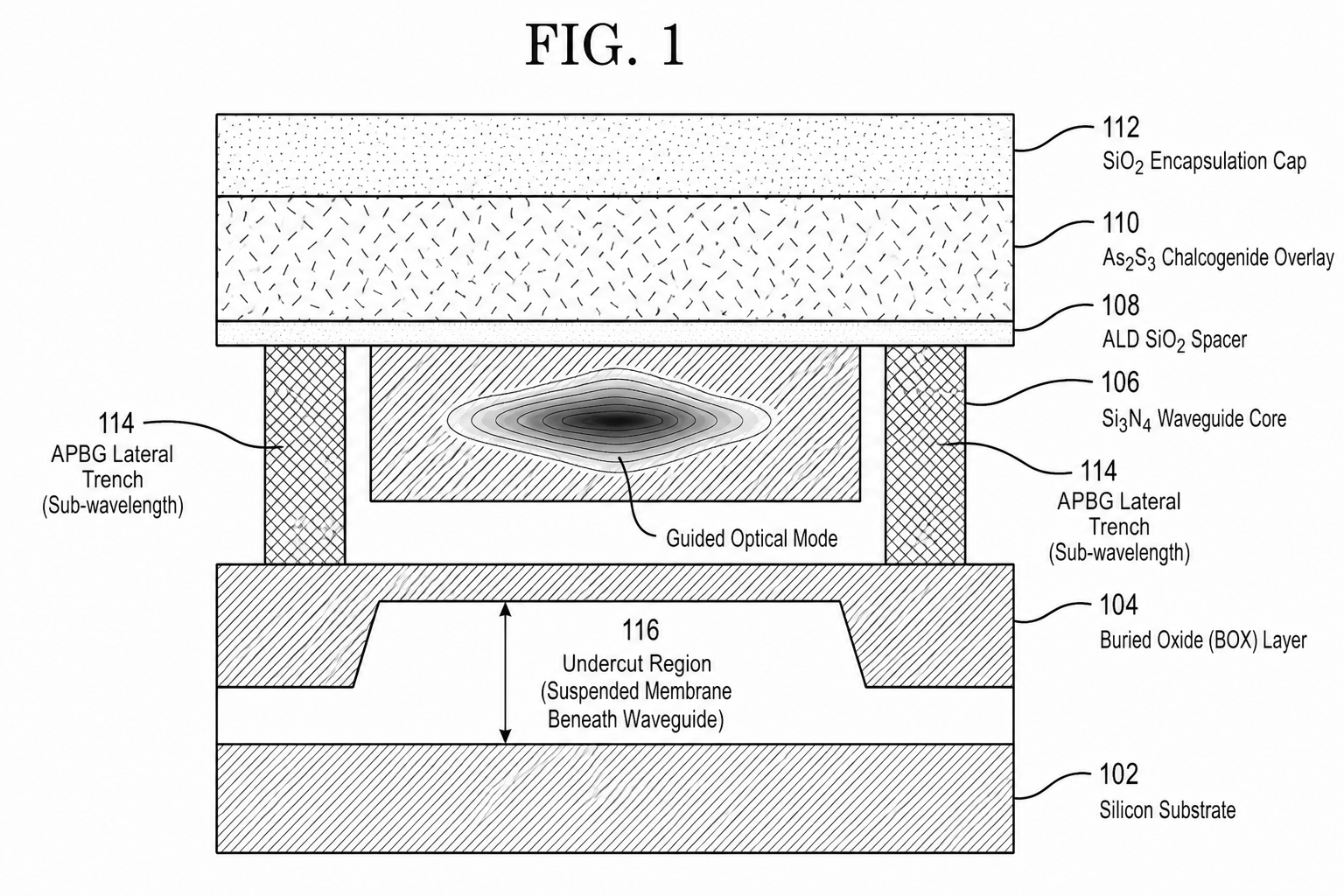
Primary Optical Waveguide
Stoichiometric silicon nitride core (800 nm × 400 nm) providing single-mode TE propagation at telecom wavelengths. Ultra-low loss <0.1 dB/cm via LPCVD deposition and high-temperature annealing.
High-Nonlinearity Cladding
Arsenic trisulfide chalcogenide glass (500 nm thick) providing n₂ ~2–5×10⁻¹⁸ m²/W. Delivers γ_eff of 8–12 W⁻¹m⁻¹ through evanescent field overlap with the nonlinear medium.
Interfacial Buffer Layer
10–50 nm atomic-layer-deposited SiO₂ separating core from overlay. Buffers refractive index contrast, smooths sidewall roughness, and acts as a diffusion barrier between materials.
Acoustic-Photonic Bandgap
Sub-wavelength periodic trenches etched alongside the waveguide core creating a mechanical stop-band. Suppresses backward-propagating Brillouin phonons by >40 dB within the target frequency range.
Substrate Phonon Decoupling
BOX layer undercut beneath the waveguide creates a free-standing membrane. Acoustically isolates the interaction zone from silicon substrate vibrations and thermal phonon noise.
Hermetic Environmental Seal
PECVD silicon dioxide cap (100–300 nm) deposited at <150°C. Prevents photodarkening, oxidation, and environmental contamination of the As₂S₃ chalcogenide overlay.
Material parameters & performance metrics
| Parameter | Value / Range | Notes |
|---|---|---|
| APBG Suppression | > 40 dB | Brillouin scattering suppression via periodic trench structure |
| Acoustic Isolation | Suspended membrane | BOX undercut decouples waveguide from substrate phonons |
| Raman-Silent Window | 7.0–7.8 THz detuning | Centered at 7.4 THz Raman-null of As₂S₃ (Choi et al. 2012) |
| Effective Nonlinearity (γ_eff) | ~10–12 W⁻¹m⁻¹ | Optimized overlay configuration; min. 5 W⁻¹m⁻¹ |
| Noise Floor | < 0.01 photons/mode | Two orders below single-photon level at 300 K |
| UV Trimming | Sub-nm ZDW precision | Post-fabrication dispersion adjustment via As₂S₃ photosensitivity |
| CW Pump Power | 100 mW – 5.0 W | APBG + linewidth broadening enables multi-watt operation |
| Interaction Length | 2–8 cm (spiral) | Archimedean spiral with Euler-curve transitions, ≤5 mm² area |
| Propagation Loss | < 1.0 dB/cm | Supports 500–1,000+ gate-depth quantum circuits |
| Operating Temperature | 300 K (room temp) | n_th ≈ 0.44 at 7.4 THz — no cryogenics required |
Built on established science
Standard SBS Mitigation
Broadening pump linewidth to increase SBS threshold is a well-characterized technique used in fiber laser amplifiers and telecom systems. QLT applies it at the integrated photonic scale.
Measured Since the 1920s
SBS was first predicted by Brillouin in 1922 and has been extensively characterized in optical fibers and integrated waveguides. The suppression targets are well-quantified.
Related patent filings
Self-Phase-Matched Nonlinear Waveguide
The base waveguide geometry that Patent 10 extends. Patent 02 defines the Si₃N₄/chalcogenide hybrid cross-section; Patent 10 adds APBG acoustic suppression for quantum-grade operation.
View Patent →Stress-Relief Cladding
Complements Patent 10's acoustic management with mechanical stress control. Together Patent 02 + Patent 10 + Patent 04 form the complete manufacturing-ready nonlinear waveguide platform.
View Patent →Periodic OPC Lattice Method
The circuit-level error correction method that relies on Patent 10's waveguide. Each OPC module in the Patent 08 lattice is implemented using Patent 10's acoustic-suppressed waveguide.
View Patent →Room-Temperature Quantum Processor
The flagship processor architecture that integrates Patent 10 waveguides as OPC modules. Patent 10 enables Patent 01 to achieve quantum-grade phase conjugation at 300 K.
View Patent →The acoustic solution for quantum nonlinear optics
Patent 10 solves the noise problem that limited Patent 02's waveguide at high pump powers. Together, Patent 02 (waveguide design) + Patent 10 (acoustic suppression) + Patent 04 (stress relief) form the complete manufacturing-ready nonlinear waveguide platform.