Continuous-Variable Quantum Processor
A monolithic photonic integrated circuit that processes quantum information encoded in the continuous quadrature properties of light — squeezed vacuum states, Gaussian transformations, and homodyne detection — with inline phase conjugation preserving squeezing through 100+ logical gates at room temperature.
Phase noise destroys squeezed states in deep circuits
Continuous-variable quantum computing encodes information in the quadrature amplitudes of light — a fundamentally different approach from single-photon qubits. But integrated CV processors face a critical barrier: accumulated phase noise from cascaded Mach-Zehnder interferometers degrades squeezing levels from 7+ dB to below 4 dB within 50 gates. Without mid-circuit stabilization, the functional circuit depth is capped well below fault-tolerance thresholds (12–13 dB squeezing required). No existing platform provides inline, non-destructive phase correction for squeezed states.
OPC-stabilized squeezed light on a monolithic PIC
QLT's CV processor generates squeezed vacuum states on-chip via parametric processes, routes them through a reconfigurable MZI mesh, and embeds inline optical phase conjugation (OPC) nodes every 5–50 beam-splitter stages. The OPC time-reverses wavefront dispersion and bounds accumulated phase variance to ≤0.032 rad regardless of total depth — preserving squeezing to within 0.1 dB of source level through circuits exceeding 100 logical operations. All-optical TFLN switching enables 46–200 fs reconfiguration. Integrated Ge p-i-n homodyne detectors provide 15.3 GHz readout bandwidth. The entire system operates at 293 K with no cryogenic infrastructure.
FIG. 1 — Monolithic PIC for CV quantum processing
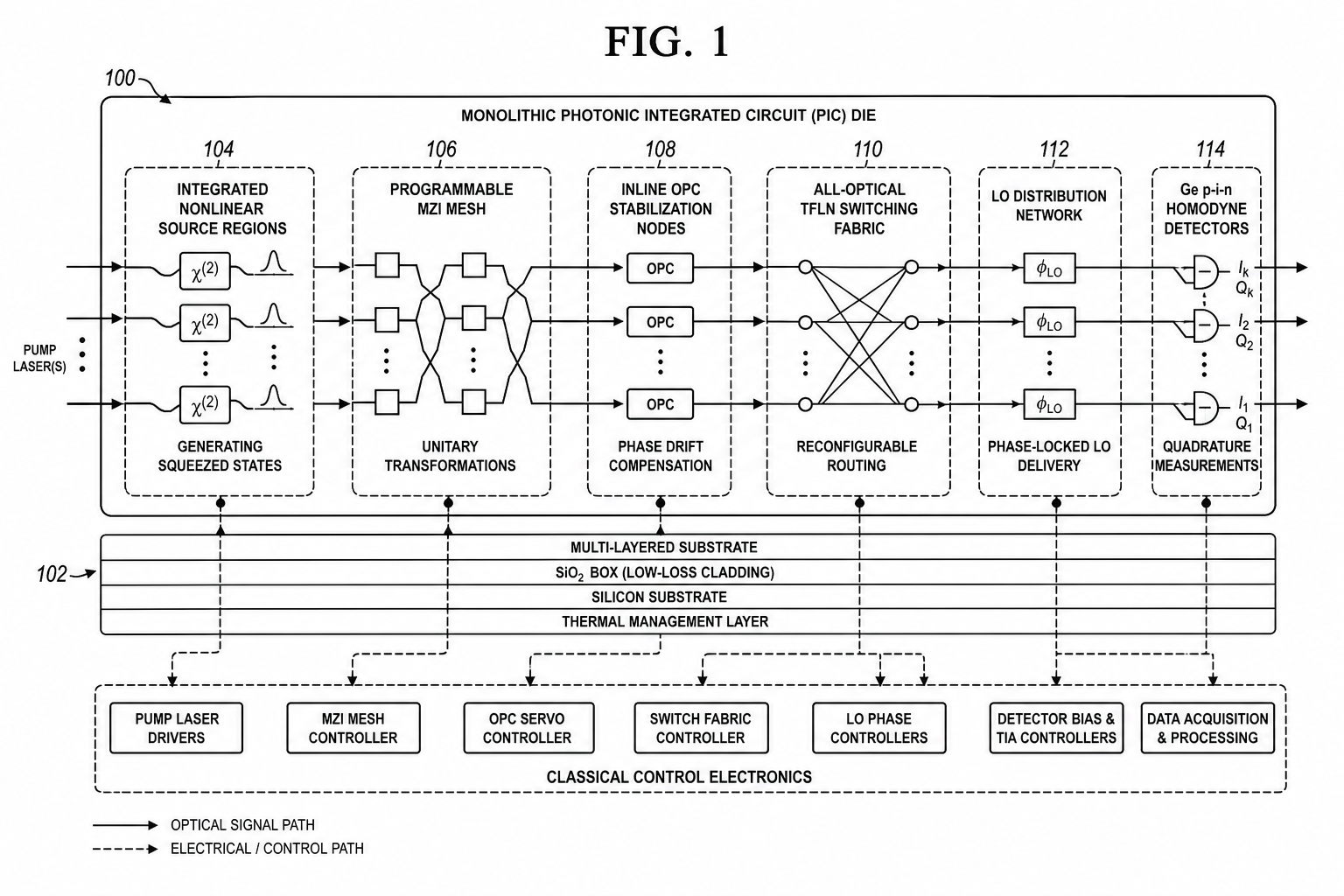
Integrated Nonlinear Source Regions
High-χ⁽²⁾ MgO:TFLN or χ⁽³⁾ Si₃N₄ waveguides generating squeezed vacuum via spontaneous parametric down-conversion or four-wave mixing. Deterministic 100% generation probability at telecom C-band (1550 nm) with ≥4–7 dB inferred on-chip squeezing and co-fabricated 40 dB pump-rejection filters.
Programmable MZI Mesh
Reconfigurable N-mode interferometer (Clements/Reck decomposition) implementing arbitrary Gaussian unitary transformations. 64-mode configuration yields ~2,016 MZI cells with per-element phase precision of ±0.001 rad. Supports CV cluster-state generation, Gaussian boson sampling, and variational quantum algorithms.
Inline OPC Stabilization Nodes
Nonlinear waveguide sections performing four-wave-mixing phase conjugation at intervals of S=5–50 stages. Time-reverses accumulated wavefront dispersion and thermal phase drift. Bounds phase variance to √S × 0.01 rad per section. Provides parametric gain to compensate insertion loss. Operates in noise-constrained regime (<1 spontaneous photon per temporal mode).
TFLN Switching Fabric
MgO-doped thin-film lithium niobate electro-optic switching (committed v1 baseline, sub-nanosecond). A more aggressive ferroelectric domain-toggling mode actuated by all-optical control pulses (reported 46–200 fs response) is a verification-pending upgrade path. Enables pulse-by-pulse temporal reconfiguration and conditional non-Gaussian operations via feed-forward routing.
Symmetric LO Distribution Network
Y-splitter tree delivering phase-matched local oscillator (derived from the same pump laser) to all homodyne channels with deterministic precision. Eliminates external phase-lock loops. Ensures common-mode rejection of laser phase noise across all detection channels with >30 dB suppression.
Ge p-i-n Homodyne Detectors
Integrated germanium photodiode pairs in balanced configuration for coherent quadrature measurement. 15.3 GHz bandwidth enables clock rates orders of magnitude faster than single-photon counting. Common-mode rejection ratio >30 dB. High-speed electrical outputs support real-time CV state tomography and cluster verification.
Performance parameters
| Parameter | Specification | Notes |
|---|---|---|
| On-chip squeezing | ≥10 dB (inferred) | 4–7 dB directly measured; preserved through 100+ gates via OPC |
| MZI mesh phase precision | ±0.001 rad | Per-element setting accuracy in 64-mode mesh |
| OPC conversion efficiency | >50% | FWM-based; provides parametric gain to offset insertion loss |
| Switch speed | Sub-ns (committed) | TFLN electro-optic committed baseline; fs-class domain toggling (46–200 fs) is a verification-pending upgrade |
| Homodyne bandwidth | >10 GHz (15.3 GHz demonstrated) | Integrated Ge p-i-n balanced detectors |
| Common-mode rejection | >30 dB | Symmetric LO distribution; eliminates laser RIN |
| Operating temperature | 293 K (room temperature) | No cryogenic infrastructure required |
| Circuit depth | >100 logical gates | OPC bounds phase error to 0.032 rad regardless of depth |
| Mesh modes | 64 (scalable to 128+) | ~2,016 MZI cells in Clements decomposition |
| Power dissipation | <150 W (64-mode) | All-optical actuation eliminates resistive heating |
| Operating modes | Triple-mode (CV quantum / DV quantum / classical analog) | Software reconfiguration only — no hardware swap |
Why this matters
Three Compute Modes
CV quantum computing, discrete-variable quantum computing, and classical analog computation on a single chip — no hardware swaps. Maximum revenue per silicon die. Software-only mode switching.
No Probabilistic Sources
Squeezed vacuum states are generated deterministically by pumping nonlinear waveguides. No reliance on probabilistic single-photon sources — 100% generation probability. Eliminates heralding overhead.
15.3 GHz Homodyne
Integrated germanium photodetectors provide homodyne measurement at 15.3 GHz bandwidth — enabling clock rates orders of magnitude faster than single-photon counting detectors.
No GKP Encoding Required
Phase conjugation provides continuous analog error correction on standard squeezed states without requiring complex Gottesman-Kitaev-Preskill grid states, photon-number-resolving detectors, or non-Gaussian state preparation.
46–200 fs Switch Speed
Thin-film lithium niobate switches with ferroelectric domain engineering achieve response times of 46–200 femtoseconds for real-time circuit reconfiguration — enabling THz-rate analog tensor processing.
293 K Operation
The entire processor — sources, gates, error correction, and detectors — operates at room temperature. No dilution refrigerators, no cryogenic infrastructure, no 15 mK cooling for any component.
Built on established science
Nobel Prize Physics
Squeezed states of light have been experimentally demonstrated since the 1980s. The 2005 Nobel Prize (Glauber) recognized coherent quantum optics. Xanadu, NTT, and university groups have demonstrated squeezed-light quantum processors on-chip (Nature Photonics, 2026).
Standard Quantum Optics Tool
Homodyne detection for continuous-variable measurement is a standard technique used in hundreds of published experiments. Wafer-scale Si₃N₄ squeezing platforms with integrated detection have been demonstrated at CMOS foundries (arXiv 2509.10445).
Theoretically Established
Gaeta & Boyd (Physical Review A, 1995) proved FWM-based phase conjugation preserves squeezing properties of quadrature-squeezed fields. The conjugate maintains reduced noise in the squeezed quadrature without state collapse.
Foundry-Ready Material
Thin-film lithium niobate is fabricated at commercial foundries with sub-100 nm waveguide dimensions. Electro-optic and all-optical modulation in TFLN has been demonstrated by multiple groups at speeds exceeding 100 GHz.
Related patents in the QLT portfolio
Room-Temperature Photonic Quantum Processor
The complete processor architecture that incorporates this CV subsystem. Patent 06 extends Patent 01's discrete-variable capabilities into the continuous-variable domain on shared hardware.
View Patent → Patent 02 · Nonlinear WaveguideHybrid Nonlinear Waveguide for OPC
The engineered waveguide structures used in Patent 06's OPC stabilization nodes (108) and nonlinear source regions (104) for both squeezing generation and phase conjugation.
View Patent → Patent 03 · Ultrafast SwitchUltrafast Optical Switching System
The quantum-grade TFLN switching technology (110) enabling 46–200 fs reconfiguration for pulse-by-pulse temporal allocation and conditional non-Gaussian operations.
View Patent → Patent 08 · OPC Lattice MethodPeriodic Optical Phase Conjugation Method
The foundational OPC lattice methodology that Patent 06's inline stabilization nodes implement — periodic phase conjugation to bound cumulative phase variance in deep circuits.
View Patent →Extending the core into continuous-variable computing
Patent 06 opens an entirely separate market vertical using the same core hardware (Patent 01, Patent 02). It bridges the discrete-variable and continuous-variable quantum computing paradigms on a single platform — targeting both measurement-based quantum computation (MBQC) and near-term Gaussian boson sampling applications.